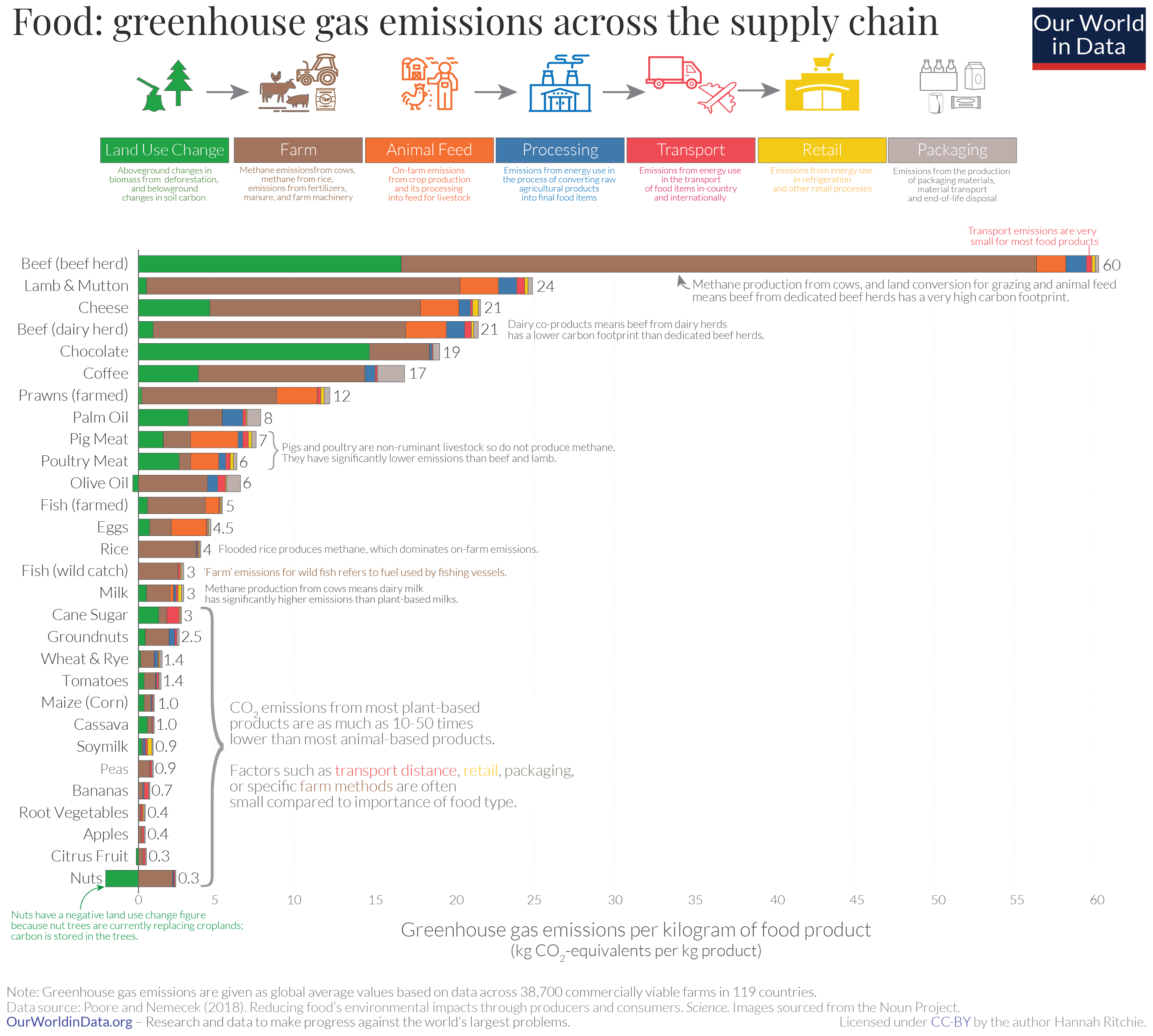
One of the most dramatic changes an individual can make is switching to a plant based diet. Don’t support fishing, don’t support animal agriculture, and you’re way ahead. Not only in energy expenditure but resource utilization as well. It’s a stunning difference.
Doesn't shipping plant-based food around the planet cause massive climate change?
PLant-based diets only make sense if you live somewhere where it's ecologically cheaper to eat plants than animals. This doesn't work, for most of the world.
As others have pointed out, the data shows that it clearly works well for most of the world.
For cases where it doesn’t make sense (these are exceedingly rare), they should do what works best for them.
If we were to ship the equivalent calories and nutrition in vegetable form we would be able to ship it earlier and more often than the meat, too. Plant based nutrition is more abundant, more efficient, and more secure in almost every region of the earth.
The only case where meat makes rational sense is generally when you prefer the taste and/or calorie density. This doesn’t often make sense on a population scale. I don’t think it makes sense for individuals either, but that is still considered opinion these days.
There is a Kurzgesagt video on that exact point. Their analysis is that the emissions from shipping plants from further away to make your tofu is a drop in the bucket compared to the emissions you won’t be generating anymore by not consuming meat anymore. Meat which has to also have their food plants shipped around to them, on top of everything else.
I eat a plant-based diet but I don’t have an ethical problem with buying used wool sweaters or used leather belts/shoes. Also if a cookie or something is free or going to waste, I won’t ask if it has egg or milk in it as an ingredient.
You don't feed livestock soy, it's too expensive. The animal feed that contains soy is made from the stuff that humans can't eat - roughly 80% of the plant mass of soy is simply inedible by humans.
If you've got a clever trick for using this without running it through a cow, you'll be rich.
Otherwise, what are you going to do with it? Pile it up and let it rot, releasing even more carbon dioxide and methane?
You won’t do me once me that feeding cows food humans could eat is a good thing, or that raising meat isn’t an environmental train wreck, or that processing grain through cows to then eat them is more efficient than eating the grain ourselves without a cow in between.
I've never in my life seen people feeding corn, maize, or soy that is human-edible to cattle. I can't imagine why you'd do that, either, because it's not very nutritious for them and there's a limitless amount of grazing.
Is it possible you're concentrating your view of livestock farming to the very artificial "feedlots" that they have in parts of the US where there's basically nothing for anyone to eat and no water?
If this was true, 87%+ of US beef wouldn't be from feedlots; they'd be grazing on limitless grasses instead.
In the USA in 2019, about 87% of beef came from large feedlots. A lot of other farming is done in densities too high for grazing, so they are bulked up on externally sourced grasses and grains until slaughter. Some may spend time outside or actually grazing, but in North America this isn't common and it isn't in many other countries either. Feedlots are commonplace in Europe and Asia as well.
Canada is not much better with 69% coming from feed lots in 2020. Interestingly, and sadly, national herd size is decreasing while feedlot capacity is increasing. If this is to keep up, that 69% will balloon quickly and real grazed beef will be a rarity.
The bottom line is that we like to imagine our meat comes from nice places, but statistically that is exceedingly improbable for the majority of people. We are dreaming. We say no way, the meat I eat comes from [insert nice idea here], I'm an exception, but the reality is that's likely something that was marketed to us at best and not reality.
> I've never in my life seen people feeding corn, maize, or soy that is human-edible to cattle
This isn't relevant. The plants we feed livestock don't magically appear; we grow them in order to feed livestock. We could stop. They are resource intensive products we produce specifically for feeding livestock. In the case with soy, a lot of it is pressed for oil and the remaining defatted material is fed to cows. Should that material be waste? No, of course not. Could we use better oil crops with less edible/waste byproducts? Absolutely. Soy is viable as an oil crop because it's so heavily subsidized; we could be investing in higher quality oil crops instead and using land to grow soy for humans instead of livestock.