I'm not a huge fan of how deadweight loss is defined in the article:
> virtually all economists agree that land value tax has zero "deadweight loss"–a fancy word for a drag on the economy that makes certain activities no longer profitable
Property taxes tax the land + the building. Building taxes are complicated to assess. They require tax assessments, appraisers, tax code, accountants to compute depreciation schedules, etc. The deadweight loss of property taxes is the economic loss of having resources devoted to filling out property tax filings. Appraisers and accountants would do other productive economic activities if they didn't spend all their time filling out tax forms.
Property taxes also distort incentives. If you improve your property, then you pay more tax. Property taxes can discourage you from using your land to its highest and best use.
Land taxes offer the opposite incentives. They encourage you to make your property better.
Land taxes would arguably help a lot of the housing crises. Landowners have to pay a lot more taxes if they want to convert a lot with a single family home to a 4-plex. A land tax wouldn't impose an additional tax to the landowner for improving the value of their land.
> The deadweight loss of property taxes is the economic loss of having resources devoted to filling out property tax filings.
This is true, but it's minor. The main one is this:
> Property taxes also distort incentives. If you improve your property, then you pay more tax. Property taxes can discourage you from using your land to its highest and best use.
In particular, it's what happens after the incentives are distorted. It becomes unprofitable to increase the housing stock, so housing becomes more expensive, so people have to pay more for it. This can be a huge amount of money and it's deadweight loss.
> Land taxes offer the opposite incentives. They encourage you to make your property better.
It's not that they encourage it so much as that they stop discouraging it. You don't pay any less LVT if you develop your land, but you also don't pay any more.
> Land taxes would arguably help a lot of the housing crises.
This still depends on zoning. It doesn't matter how profitable it would be to have a 4-plex on your lot when building one is prohibited by zoning. And fixing the zoning would have the larger benefit, because in the places that matter, that's already the constraint, which LVT on its own can't get you out of.
> It becomes unprofitable to increase the housing stock, so housing becomes more expensive
There's no way that this occurs with actual property taxes at the levels they are in the US. Sure, an improvement may result in higher property taxes which go into effect before the value of the improvement begins being realized, but overall effective property tax rates in the US range between 0.37% and 2.22% per year; this plausibly could make uses where the value would be realized entirely in direct-use by the owner unviable, but there is no way it makes any use where the value is realized through commercial exploitation (whether productive or rent) unviable, even with something of a delay in realization. Including things like densifying housing for rent or sale.
Yes, abstractly it might be a problem with property taxes, if you had a system where property taxes were the principal tax in society. Of course, the only people who even propose real estate taxes as the primary tax are…Georgists arguing for a heavy LVT replacing other taxes.
> It’s not that they encourage it so much as that they stop discouraging it
No, especially if they are heavy (as LVT proponents often propose), they don’t merely “stop discouraging” improvements, they make them necessary, because land uses that don’t provide a substantial fraction of the income potential of the land become unviable. In fact, land ownership by people who don’t have capital for both improvements and to stay afloat until those improvements bear fruit becomes unviable; a heavy LVT is an efficient way to assure acceleration of the concentration of land ownership.
> Sure, an improvement may result in higher property taxes which go into effect before the value of the improvement begins being realized, but overall effective property tax rates in the US range between 0.37% and 2.22% per year; this plausibly could make uses where the value would be realized entirely in direct-use by the owner unviable, but there is no way it makes any use where the value is realized through commercial exploitation (whether productive or rent) unviable, even with something of a delay in realization.
Why not?
Suppose you could invest $100,000 to create housing in an area where that would have a 5.5% ROI, compared to a 5% ROI for some non-housing alternative investment with equivalent risk. Then you're going to build housing. Add a 1% property tax and you're going to invest the money in the other thing instead until local rents increase to raise the housing ROI.
> No, especially if they are heavy (as LVT proponents often propose), they don’t merely “stop discouraging” improvements, they make them necessary, because land uses that don’t provide a substantial fraction of the income potential of the land become unviable.
That doesn't actually change the math.
Suppose you could spend $100,000 to construct more housing on your property and then, in the local housing market, the additional housing would have a net present value of $90,000, e.g. because local rents are already low. Then you're not going to do it, because you'd just lose $10,000.
If you suddenly owe a lot of land value tax, you're still not going to do it, because losing $10,000 more doesn't help you pay the extra tax.
Whereas if you could spend $100,000 to produce something with a net present value of $200,000, you were going to do that either way.
The weirdest thing about LVT is that if you got rid of the disincentive to build from property tax (and, of course, restrictive zoning) then the "land value" would crash because if rents were higher than construction costs then construction would happen until they weren't. At which point housing scarcity would be low and collectable rents would be predominantly attributable to construction costs, and only higher in cities to the extent that higher density structures have a higher construction cost per unit area.
But the same thing happens just by getting rid of property tax and restrictive zoning, doesn't it?
Encourages in the sense that leaving land empty while it gains value is easy and free. Once you are paying for that land you have to do something with it otherwise it costs more than the inflation of the value.
I was recently in Egypt and they have a tax on finished buildings. So naturally no building is ever finished. It is a very weird sight that 90% of the buildings don't have windows and uncompleted roofs.
IMO the biggest issue with property taxes, land taxes, or any other similar idea, is that they arbitrarily tax one kind of wealth over others. Why should a person who owns a house worth $500k (and perhaps has a mortgage on it) pay not only the exact same tax rate, but also the amount of tax as a person who owns a house worth $500k (and doesn't have a mortgage on it), but also has $5 million in other assets? (This isn't even getting into the fact that the wealthier you are, the less of your total wealth is likely to consist of land/property/etc.)
Owning huge amounts of land is uniquely antisocial in a way that owning huge amounts of other stuff isn't. If Mr Moneybags buys ten thousand paintings, we can always produce more paintings (and the rising price of paintings will push more people to take up careers in art). But if Moneybags buys ten thousand acres, the rest of us are ten thousand acres worse off in a way that we can't really fix.
This isn't connect to just the scarcity of the land. People can live without bitcoin and the Mona Lisa, but you can't live without land. If you want to take this to the extreme imagine if somebody owns the whole country. Housing is a human right.
It is? It’s “Life, liberty, and the pursuit of happiness”, not life, <deleted> and purported happiness under socialism, where you are assigned housing and a job.
Housing was guaranteed in the old Soviet Union, but if you didn’t cooperate, the housing was in the gulag.
The post didn't use the word scarcity. Land isn't even scarce, most land is effectively uninhabited compared to the population densities most people live at. Humanity at large is not short of land.
Land is quite unique. It is the resource with the weakest argument that humans produce it. Gold, for example, requires human labour to be dug up. Bitcoin requires humans to run machines. The Mona Lisa requires humans to paint. Land behaves differently.
The post I was responding to makes the distinction between things we can't create more of (land) and things we can (paintings). I used scarcity as an (erroneous) proxy for this distinction, even though obviously there are scarce things that we can create more of.
> Land is quite unique. It is the resource with the weakest argument that humans produce it.
I mean, not really. What about water or oxygen? What about carbon taxes insofar as they're related to the inherent value of the earth's climate? There are plenty of resources that don't require any human effort to produce, but that doesn't make them better suited to taxation. It just seems like an entirely arbitrary distinction to make.
I agree 100%. Originally land taxes were conceived as a correction for a more subtle bit of economic inequality: productivity of fields.
In today's world, where access to a city can dramatically change one's earning potential far far more, they are even more relevant.
The issue is both about the scarcity of access to a resource, such as the economy of a city, but also about where that resource comes from. With urban land, that resource is not the product of the individual land owner, but rather all the other land owners that made the city so prosperous and with so much opportunity.
Yes, it is (or, at least important subsets of land are.) If it wasn't, it would have zero value. Nonzero market value requires, and therefore proves, scarcity.
The value of gold is mostly the cost of labour etc. to extract it; to the extent that it's just the value of the land that it was dug out of, sure, I'd support taxing it. Most Georgists support extending the land value tax to other kinds of economic land e.g. slices of radio spectrum. But physical land is the big one that affects society (particularly because everyone needs some land to live on), so it's the most important one to tax.
But it's important to note that this is a different question than if the roads have tolls on them. (Not that you implied that in any way, but it is a confusion that happens!)
Rather, the tax on the land of the roads is an accounting mechanism to ensure that the land is being used for greater economic efficiency, rather than, say, a way forward wealthy people who live far away to get the public to subsidize the transport to their large mansions.
Everyone needs a certain number of square meters to live, work, and grow food in (or indirectly, for others to grow food for them). The same isn't true for the assets you mentioned.
It's almost entirely "used." The places that look "empty" are pasture, fields, private timberland and national parks, and the few remaining pockets of actual nature should probably be left the hell alone.
There are ten thousand small towns (like, say, Bird Island) whose population has been declining for decades, due to lack of economic opportunity. You don’t have to choose between a city and an isolated home.
Those are ten thousand paintings which the public cannot experience or enjoy! In many ways, the paintings are more precious, as they could go on worldwide tours, and be experienced by millions of people; most land has virtually no uniqueness, and cannot be shared.
Most paintings sit in museum storage and are hardly ever seen by anyone (maybe the occasional grad student specialising in that particular artist).
Obviously I'm assuming an equal monetary value of paintings vs land; my point is not about how many acres equal how many paintings but about the impact on other people that taking $1M of paintings vs $1M of land out of circulation has.
I completely agree with you regarding museums holding large collections which they do not exhibit; in fact, I think it highlights how a sort of 'George-ish' tax on paintings might be helpful!
With respect to your second point, I think that taking each out of circulation has different effects. I would guess that most assets have a value of about what they're worth (i.e. the price mechanism works). I think Georgism is at least a valuable paradigm, and would be in favour of at least some pseudo-Georgist measures, such as only taxing land, to encourage higher-value uses rather than land+structures, and taxing all sorts of land at the same rate.
> I completely agree with you regarding museums holding large collections which they do not exhibit; in fact, I think it highlights how a sort of 'George-ish' tax on paintings might be helpful!
I'm not convinced; after all these collections are often already in public ownership. If there was something more beneficial to the public to be done with them, one would hope that would already be happening.
See: Owning huge amounts of land is uniquely antisocial.
The point here is to maintain a society and some things must come first, namely material things which paintings are not. Of course, art history shows us time and time again the vital importance of material sustenance in creating and preserving works of art. If you really care about art, you have to care about the material foundations that make rich and meaningful social livelihoods possible.
You emphasize "antisocial", and I am not sure why. I looked it up to double-check, and the main definition is "contrary to the laws and customs of society; devoid of or antagonistic to sociable instincts or practices." Could you please explain what you mean by "uniquely antisocial"?
>"If you really care about art, you have to care about the material foundations that make rich and meaningful social livelihoods possible."
I care about all the tiers of Maslow's hierarchy of needs, and I think that many paintings are worth a lot more than most 10k acres. The paintings also have the benefits of being able to contribute to shared experiences all over the world, and fulfilling more challenging needs.
I'll take the 10k acres, wherever it may be: meadow, forest, desert, wherever, and enjoy not only the ability to sustain myself, but the beauty and meaning that one can only find in nature. The same beauty and meaning that every artist from the first ape to feel artistry to now has tried, and failed, to fully capture.
the thing that is scarce is, depending on the country, not even really land itself but really proximity, connectedness in the graph of resources. price of land goes very high where there are lots of jobs and good schools....
One good reason to tax land is that its one of the few resources that we can't expand production of. Until traveling to other planets is cheap, land is a very limited resource so it is a major benefit to prevent the rich from hoarding it. For much of early Roman history, it was illegal for anyone to own more than a certain amount of land.
Georgism makes a distinction between Capital (value produced by labor) and Land (value that existed before humans showed up). Rewarding owners of capital incentives people to make more, but rewarding owners of land benefits nobody other than the landowner.
I'm not sure that meshes with the way it's actually described in the article. They give examples of a small piece of land worth $2M and then another plot in a different location that's worth far less, purely due to proximity to other improvements on the land (i.e. being prime real estate in a city) rather than something inherent to the land itself (e.g. fertility/use for growing crops).
And even then, something like fertility isn't really all natural any longer, given how it's impacted by so many farming practices (fertilization, tilling/no-till, crop rotation/nitrogen fixing crops, etc.).
Resource extraction (e.g. oil) seems a lot closer, though the actual labor of it vs. the resources of it are another thing. I do see more reason there why the benefit ought to be largely public--and to some extent it is in, e.g., Alaska via the Alaska Permanent Fund.
But I think that labor, improvements and whatever the intrinsic value might be are a lot more tied together than seems to be accounted for by the theory. Otherwise why is the intrinsic value of Manhattan's land not measured in some number of beads, with everything else being due to improvements (including those made by neighbors)? And yes, I do realize that beads actually were money for a time due to a lack of actual currency, but still.
You’re right. When Henry George introduced the land value tax, he made it clear that in urban areas he wished to capture the value which is created by the community while the landowner sits and collects increasing rents, not value that existed naturally (https://www.henrygeorge.org/pchp19.htm):
> All these advantages attach to the land. On this land — and no other — they can be utilized. For here is the center of population: the focus of exchange, the marketplace, the workshop of industry. Density of population has given this land productive power equivalent to multiplying its original fertility a thousandfold.… The most valuable lands on earth, those with the highest rent, are not those with the highest natural fertility. Rather, they are lands given a greater usefulness by population density.
That seems like a bit of a murky distinction, though, right? Taxing land disincentives economic activity a large component of which is in the land value (running a parking garage or hotel in downtown Manhattan, or a farm in a fertile region, etc.) but incentivizes other types of economic activity.
It doesn't _absolutely_ disincentivize these things unless they are operating at a loss. It certainly disincentivizes "economic activity" like opening an at-grade parking lot in a bustling city-center in order to minimize the property tax you pay while the land appreciates in value more than it disincentivizes opening a parking garage there (assuming there's actually enough parking demand to pay to build and maintain).
(I don't entirely disagree with you--it seems like this would shunt some investment away from investments that need expensive land. It's less clear to me whether that is good, neutral, or bad.)
Land taxes are great because there is less of a deadweight loss. Governments need money to operate. All else equal, we should get governments the money they need without wasting people's time to comply with complicated tax laws.
Humans also generally agree that progressive taxation is a good idea. Rich people should pay more to fund the government. Rich people own a lot of land, so they'd pay a lot of land tax. Poor people generally don't own any land and wouldn't be subject to this tax. Land taxes align well with what a lot of people think is fair.
Another key factor is enforcement cost. Enforcing a land tax is really easy for a government. You just... Go there and get it. There's no moving the land offshore or having complex relationships or offsets. If someone won't pay the government just assigns the ownership to someone who will and goes on.
Compliance costs with many other taxes are quite high.
Wouldn't a land value taxes be regressive for condos as the more expensive ones are on higher floors and would pay the same rate as people on lower cheaper floors?
This question is out of the scope of land value taxation. The overall tax burden would fall on the institution running the condo (HOA/company/whatever). How they decide whom to charge and how much, etc. would be a separate question government by different rules and laws.
Which is not to say that the outcome would be fair, but whether it is or not would depend upon how these organizations are regulated and run.
I don't think it is out of scope though because wether the government or your HOA/whatever is deciding how to appropriate the LVT is at the whims of someone else. I'm mostly for LVT but it gets supper messy with multiple ownership properties on land.
Also, LVT don't fix zoning as the value of your land is based on what you can make from it. If your land is zoned for only single floor parking, nobody is going to buy it for more than they can earn through single floor parking so the land won't be that valuable thus it won't have a high land value tax.
Why would they pay the same rate? From my understanding, the condo corporation would receive the tax bill. It would then be up to them to determine how they should charge the individual units.
Generally speaking no. When there needs to be major maintenance, each condo unit owner pays N% of the cost where N% is defined as your ownership stake (also your voting weight) in the condo. N is roughly your unit's square footage / the sum of every unit's square footage.
> Humans also generally agree that progressive taxation is a good idea.
Fairly bold assertion. I'd say most humans don't even really know what progressive taxation means.
> Rich people should pay more to fund the government.
A static tax regime (i.e., taxes calculated by a simple fixed percentage of wealth or income) leads to the same outcome. E.g., in a 10% fixed tax regime, someone making $10k/a pays $1k in tax and another person making $1mm pays $100k in tax, meeting your desire to have the rich pay more--no progressive taxation required.
I’d like to add here that the biggest fallacy is assuming rich pay income tax at all, which leftists across the world all seem to universally believe.
I would argue that in 21st century the definition of rich is actually „achieves most of his income through sources which are not subject to income tax”.
Progressive income tax mostly hurts well qualified proffessionals nowadays (people actually working for that income) and as such is detrimental to economy at large.
This isn't true. If you define "income" as the sum of an individual's income from capital plus income from labor, it is only in the top 0.1% of the distribution that capital income dominates labor income. (This percentile threshold changes slightly based on country; in countries such as the United States it'll be a bit higher.)
And? Due to power-law distribution that 0.1 % holds disproportional amount of riches.
I really don’t get that people talk about rising income inequality all the time, but actually noticing it (i.e. very strong minority holding many assets) suddenly doesn’t make sense.
No one is denying that income and wealth are distributed very unequally. But my point is that well more than 99.9% of individuals primarily earn money via labor and are therefore subject to an income tax, and so it isn't correct to assert that income taxes don't hurt the rich. They don't hurt the absolute richest individuals - but most people aren't defining "the rich" as only the top 0.05%.
"Rich" is an ambiguous term; there clearly isn't a single definition. That being said, I think most people would agree that an individual who earns a salary of $500k a year (~99th percentile in the United States) is clearly "rich."
The question I'd put back to you is why it's useful to have a single, universally agreed-upon definition of "rich"?
It comes down to the purchasing power. If you tKe $100 from someone with only $1000, it affects their ability to live more than taking $100M from a billionaire
eh, what? The tax on $500K worth of stock or gold is zero. Also, home ownership is disincentivized by property taxes but also incentivized by the mortgage interest deduction, one of the largest non-corporate tax subsidies in America. And rental property is taxed very differently from property you live on.
I think it's better to say that land is sort of a one-off that is treated differently from every other asset than to try to compare it to other kinds of wealth.
Taxes aren't an objective truth handed down from on high; so, in some sense, all taxes could be considered arbitrary. In this case, taxing one kind of wealth more than another is a lever the state has to (dis)incentivise certain behaviours and thus create a better society (although in some cases, you may fairly ask - better for whom?).
>IMO the biggest issue with property taxes, land taxes, or any other similar idea, is that they arbitrarily tax one kind of wealth over others.
In theory. IMO the practical biggest issue with property tax is that it is usually spent locally, keeping rich neighborhoods well funded and poor neighborhoods poor.
That sounds like you want a tax on communities, not a tax on land. Inasmuch as this is due to a location/group-based "neighbourhood value-add", it seems better to tax the neighbourhood as an organization than to tax the ground they happen to be on.
>IMO the biggest issue with property taxes, land taxes, or any other similar idea, is that they arbitrarily tax one kind of wealth over others.
Exactly. They tax wealth created by nature and/or the community rather than wealth created by individuals. The land Trump Tower sits on isn't valuable because Trump owns it. It's valuable because all of New York surrounds it.
A $5 million fleet of cars is wealth (mostly) created by human hands. Those human hands ought to decide what happens to them. Right?
There's also raw materials, but they would be subjected to a georgist tax too.
> Exactly. They tax wealth created by nature and/or the community rather than wealth created by individuals. The land Trump Tower sits on isn't valuable because Trump owns it. It's valuable because all of New York surrounds it.
Yeah, but pretty much all private wealth is built on top of thousands of years' worth of accumulated community knowledge. The startup you founded wouldn't be worth anything if not for electricity, computers, and the internet.
If I buy a hamburger should the sales tax depend on my wealth?
The property tax should be based on the value of the property, period. If you want to tax mythical wealth do it via some other means.
And whether the person owns the property outright or borrowed money shouldn't have any bearing on the value of the tax.
I have felt for awhile societal fees/fines should be tied to income.
A wealthy man gets a $270 red light ticket. (This is the one where turning right on a red light is illegial. It seems like they arbitrarily decide which intersection to enforce?). The wealthy man casually mentions it over din din. Goes to sleep, and has the help drive his spawn to private schools. Yea--I live in a county filled with rich people, and they are obnoxious on so many levels.
To the poor man it might be part of his rent.
So yes--if I ran things; The wealthy would pay more at DMV, bail, patent fees, incorporation fees, etc., and especially property taxes. You want a third mansion so you don't have to look at your neighbors---get ready to pay Zuck.
I would love to see Jay Leno pay a $100,000 speeding ticket.
No... They aren't "trying" anything; it's been standard practice for decades, probably over half a century. Not just for speeding tickets, but many fines in general. And not just Sweden, but most of the Nordic countries, plus Germany.
Land taxes are far far more difficult to calculate than property taxes. Impossible to do well in some cases. To know what land and the buildings on it are worth you can look to what people are willing to pay to buy them. There’s no similarly straightforward way to value the separate parts. So you’ll end up with a lot more wasted expert time for a less accurate result.
Nah, it's really easy to calculate the value of the land. Once you calculate the value of the land, then it's pretty much applicable to the whole neighborhood too. It's a one-and-done analysis. This isn't my opinion. There's lots of economic research to back this up.
This really doesn't make sense. Views matter for example, land with a blocked view should be worth less than land without the blocked view.
Land immediately adjacent to a golf course or park is often valued higher. Land immediately next to railroad tracks or industry, not so much while the discount drops off steeply just a few blocks away.
Water rights, drainage, soil quality, contamination, roadway access all matter a great deal for more commercial land.
I agree that different factors cause some land to be more valuable than others.
I'd argue that the factors you've listed are relatively easy to factor into an appraisal.
Property taxes, in comparison, are really hard to compute. Each jurisdiction has different rules. There are different valuation methodologies. If you add a 2 car garage, what the useful life. What depreciation schedule should be used. How should inflation be accounted for.
I agree with your comment generally and am not sure what part of the original comment doesn't make sense to you.
EDIT: Reread my original comment and see your point now. I phrased the "easy" part too strongly. I mean "easy" in relative terms... compared to what's being done currently, but agree the wording wasn't great.
Yeah, and these features are easier to track than the interior of the house.
As an aside, I've often been surprised how little some of these features get valued. For instance, I've looked at neighborhoods where one side of the street backs to other houses and the other side backs to parkland. The nicer side is generally more expensive, but it's not a huge effect, and often homes on the bad side go for more money (because of the building itself).
Ultimately wouldn't these rates be set politically? As in, there'd be one politician who says "raise the tax and do this" and another who says "lower the tax and stop doing that" and voters just pick what they want to happen.
Then you end up with preposterous situations like California boomers hanging onto property where the value (and thus the property tax) was last assessed in the 70s.
this is a far better situation than rich neighbors moving in next to a lower-middle-class family and driving them out of the neighborhood by bringing up the assessed value.
Since rich people are rare, by definition this wouldn't happen very often. Unlike with the current situation in California where it happens _everywhere_. And such a lower middle class family would still be selling their house at a higher value than for which they bought it, so it's hard to see how they are being robbed.
And don't you think it's funny: we can't have rich people moving here because that would drive up land taxes, and we can't have poor people moving here because that would drive down the total resale value. I guess people should only be allowed to live among their exact socioeconomic equals ...
you're neglecting the important asymmetry. If we fail to tax a rich person, it doesn't actively hurt someone, it may passively prevent some people (who would have wanted to move in) from having an easier time with certain life-paths. If you eject a middle class person from their home, you are actively forcing them to find a new life-path. Suppose that lower-middle class person is a mobility-challenged elderly person on a fixed income that is already being eaten away by inflation. Yes, sure, they get to sell their house at a high mark to market, but they have to suffer the hassle of finding a new place, which at best is equivalent quality minus income tax on LTCG, on an eroding deadline. That is a really shitty situation to be in.
> this wouldn't happen very often
Then, I suppose we would have no reason for the term "gentrification", if it's that damn rare.
> it's really easy to calculate the value of the land.
No, it's really easy to wave your hands and come up with a number that you claim is "the value of the land". But since that number is not based on actual sales of the land in question, it's just hand-waving. Not to mention that if you ask five different economists to do the estimating, you'll get more than five different answers. Much of the article that prompted this thread is trying to deal with this problem: there are so many widely varying estimates of land value, and no compelling reason to believe any one more than the others, because none of them are based on actual sales of the land whose value they're trying to estimate.
> since that number is not based on actual sales of the land in question, it's just hand-waving
Actual land is sold in a lot of markets. That sets a great benchmark for "comparable transaction" types of valuation analyses which tend to be the most reliable.
If one acre of land is sold, there is a great baseline for the whole surrounding area.
I passed all 3 CFA exams and agree it's not an exact science, but as far a valuation analyses go, this one is pretty easy. Valuing something like intellectual property, goodwill impairment analyses, 409a valuations are much harder.
But much more land with improvements on it is also sold, and that's the land that all these hand-waving formulas claim to be determining the "value" of--not the total value of land + improvements, but just the value of the land itself.
The local cost of construction per sq ft to replace an improvement is reasonably easy to arrive at. So is the annual cost to maintain an improvement. Then simply subtract from purchase price. The toughest part is making sure the process isn't corrupted and some people get an assessed land value far less or more than it is actually worth.
It likely wouldn't work with real estate, but low cost motorsports has a simple solution to this problem. If there is a $1000 limit on the value of the car before all the standard safety additions, then the owner has to accept $1000 from any other competitor for the car. This massively disincentives anyone from undervaluing their race car as it will simply be purchased for way less than it's worth. In real estate this would just result in wealthy people snapping up anything they thought was even slightly undervalued. Maybe value purchases can only happen when challenging a valuation with strong court-backed protection for the owner to ensure the valuation has been applied justly.
> The local cost of construction per sq ft to replace an improvement is reasonably easy to arrive at. So is the annual cost to maintain an improvement.
I'm not sure I agree with this, since construction costs are subject to a lot of government interventions that distort the market.
> The toughest part is making sure the process isn't corrupted
Oddly enough there was no evidence provided for the original claim, either. This despite there being many sources of this estimattioj laid out directly in the original article. The comment didn't mention why the original articles' various methods do not work.
Fair point. But to me, I hold the reply to a higher standard. Why? Because a claim can be interesting (in the HN sense), even without evidence. A "no it's not" is less interesting, even though it's also a claim.
> FWIW, I just looked up my own property tax records and there's no breakdown, so not sure how common that is.
>
> That said, it is done for property insurance, so I think your point that it's already done stands.
I dunno how useful that will be - my insurance is based on how much it would cost to rebuild the house if it burned down.
This lead to the comedic result that what I paid for the house at the time was about half what the insured value was. My property tax is calculated on the selling price, though.
That comedic situation is exactly the reason your insurance works like that. The insurance company knows it's in your interest to burn it down and sell the empty plot so they only insure it in a way that prevents that.
At least for Seattle, the assessor's office has a breakdown but it turns out to be fairly bogus unless there's been a remodel or new building -- resulting in a new assessment. Quite a few cities also seem to have pretty bogus values on the books.
The building value by the county assessor's office is considered a standard for depreciation schedules. While it might not be useful for selling the property or building it - it does have value for accounting purposes.
What if you had a system where anyone can bid any amount on any piece of land. Whether the owner refuses the bid or not, the land is now valued at the price of the bid for tax purposes.
To avoid frivolous bids, bidders must place funds in escrow before making a bid which is then returned to the bidder if the owner refuses the bid or fails to respond within some number of days.
All bids are reported to the public although bidders can be anonymous.
Buying land that has buildings on it but not the buildings is an awkward situation that requires a further negotiation of a lease transaction to the building owner. Even if you could set something super complicated up with this bidding system I don’t think it would accurately value what the land would be worth empty.
Inaccuracy isn't a very big component of this; assessing the value of land and structures isn't perfect but there's no obvious reason to think we're way better at one or the other. The point of this is that taxing the land only would lead to land being used differently, which would benefit society.
Suppose there is a plot of land which (from some omniscient point of view) would offer maximal benefit to society if a four-plex were developed on it. The point of a LVT is that, under a LVT, a four-plex would be developed on it, not because anyone forces it but just because that's what's in the landowner's best interest; whereas under the current system (in which the structure is also taxed) the landowner might find it more profitable to build a duplex instead. The deadweight loss is the loss to society when the landowner builds something that's in their best interests but not society's.
That's hard to prove for any specific piece of land, since we don't know what the omniscient-view "right" use of the land is. But if you accept the idea that there is an optimal use, and you you trust the whole idea of free market price discovery, it's reasonable.
Inaccuracy in the end is a HUGE component of this. If you can't have an accurate value for the land, the long-run incentives converge to a system where the land value assessors have a lot of power, and could use that power to screw you over.
> but there's no obvious reason to think we're way better at one or the other.
There’s a very good reason. Sales of buildings plus land happen all the time, whereas sales of just land are virtually non-existent in a lot of the places with the most valuable property (e.g. Manhattan). Without real sales to tether the analysis you are just guessing.
a) You're implying that we use sale prices to set the assessed value of property today; I believe that's often not true. I happen to have the tax slip for a property in front of me, the assessed value is about 80% of what I paid for it five years ago. Assessments are already inaccurate, because they're more a product of politics than science; a LVT wouldn't magically fix that, but AFAICS it wouldn't necessarily make it worse.
b) You may not be confident in your ability to distinguish the value of the land from the value of the structure, but your insurer is. If you want to know e.g. how much your home's value would improve if you finished out the basement or built a garage, they will go through it with you on the phone. Sure, it's something of a guess, but a very educated one.
I don't know. I do know that 99 Church Street sold for $170 million, and was demolished, so that that figure is the land price (before adding back the cost of demolition).
> Property taxes can discourage you from using your land to its highest and best use
I agree.
> Land taxes offer the opposite incentives. They encourage you to make your property better.
But it doesn't make the converse true. At most, you can say that high enough land value taxes encourage making real estate generate more revenue, to pay the tax. But given the current economy's tendency to optimize everything legible and whisk away the surplus upwards, it's dubious whether being pushed harder into the economic grindstone is "better".
For a rural example, well separated houses on a few acres are much nicer than ticky-tack suburban panopticon developments (or even worse an HOA). It's hard to prevent the latter from occurring over time due to the economic gradient (eg parents die and kids want the most money possible, so they subdivide), but we shouldn't be pushing it through policy.
It does work that way, though. Except it's not exactly 'better', but rather 'more economically productive', which may or may not be better depending on your value system and the specific cases that arise.
> For a rural example, a single house on several acres is much nicer than a ticky-tack suburban panopticon (or even worse a HOA).
Arguably nicer, yes, but the suburban hellscape is definitely a lot more economically productive.
> Economically it's hard to prevent the latter from occurring over time (eg parents die and kids want the most money possible, so they subdivide), but we shouldn't be encouraging it through policy.
This feels like an orthogonal issue to me, that US-style suburbia is bad. Though honestly the rural living you describe is probably no better. Oh sure, it's nice in some ways, but there's problems a plenty there too: it's more destructive for the environment per capita, and it causes problems with the intersection of the social contract and social services.
For an example of that last bit, look at the struggle with rural high speed internet. Arguably necessary for economic activity as well as educational purposes, but it's much more expensive to wire up and service super low density areas, and yet people in those areas have less money, not more. So you end up with either a) left to the free market, they have shit internet access, or b) people in urban and suburban areas subsidize them getting better internet, even though for most people there it's an explicit choice to have that lifestyle (as opposed to, say, the urban poor).
And it's not just internet: most infrastructure and services are harder to deliver in rural areas, and you can end up in shitty situations because of that. Even if you accept that it's fine for adults consenting to it, what about kids who grow up with fewer opportunities?
> the suburban hellscape is definitely a lot more economically productive
Neither dense suburbs nor rural suburbs are defined by economic productivity, because they're residences. If this shifts with work from home, their focus will still be on quality of life rather than packing people in as close as possible for more "specific revenue".
> the rural living you describe is probably no better
If you have to drive everywhere anyway, do you also want to be looking through your neighbor's windows? I do miss being able to walk many places (city living), but that isn't the density tradeoff I'm talking about here.
In general your arguments seem to be extrapolating from comparing urban to rural/suburban. Comparing rural and suburban directly, I don't find your points compelling. Going from houses on 1/2 acre lots to houses on two acre lots is one half the linear density. The costs of transportation and utilities increase a little, but aren't going to double - once you're rolling or trenching, going a little further is easy.
Furthermore I'm currently in a quasi-rural area with gigabit muni fiber, so I don't buy that argument either. Whether there is the political will to build out modern Internet access or suffer the extractive oligopoly depends entirely on the politics of an area.
> what about kids who grow up with fewer opportunities?
IMO kids in suburbia are the most caged in. Having to be driven anywhere sucks, but that's a given for both areas under comparison. Once you get past the nadir of suburbia, the increased space helps - kids in rural areas can go play outside, wander in the woods, build stuff, fly drones, etc.
>>Furthermore I'm currently in a quasi-rural area with gigabit muni fiber, so I don't buy that argument either. Whether there is the political will to build out modern Internet access or suffer the extractive oligopoly depends entirely on the politics of an area.
Our experiences color our views. I grew up in rural towns (<800 people) to cities of 15K people(! :-) ). Lack of services, lack of opportunities (library? yeah - 1 room of books from 1950), wandering in the woods was cool until about 12ish? then it was "yeah, I saw that tree yesterday..", not to mention I'm not sure how many parents these days would be comfortable letting their kids wander around - especially in 'desolate' areas ... Also, these were 'mill towns' so one employer basically employed everyone.
I ran as fast as I could when I was 18.
oh - and btw, pulling utilities can be quite expensive - 'going a little further' isn't always easy (or even possible).
So while a 'quasi-rural' (suburb with larger yards? :-) ) might be your idea of heaven, it doesn't necessarily translate well across the board.
In short, what people want/like or what is 'better' is pretty hard to get a consensus on.
I ran too, from a suburban area calling itself a city to an actual city. And I loved the walk/bike/lightrail restaurant/concert/etc lifestyle. But ultimately if you want to get some relief from the rent treadmill (which includes "buying" shared walls with unreasonably high valuations), you inevitably end up back in less dense areas.
Suburbs are certainly not my ideal of "heaven". I feel like I'm being argued with by younger people still in the phase where they're in love with the city, extrapolating my points into general indictments of density. They're most certainly not. All I'm pointing out is that once you're already past needing to drive everywhere, having the space to actually do things and be left alone is much nicer than being packed up on your neighbors.
>>I feel like I'm being argued with by younger people still in the phase where they're in love with the city, extrapolating my points into general indictments of density.
I'm actually an empty nester, and I took my car off the road like 2 years ago cuz I never use it. I put in a server room, electronics workstation, basic woodworking, and a bunch of 3d printers. Couple that with being in a small 'city' now (500K people) and I really like the balance. Plenty of space in the house (1700 sq ft), no huge yard to maintain, can get pretty much anything delivered, no septic/well to deal with. I'm very happy with how its working out for me. On the other hand, I think I only have a 7500sq ft lot (1700 of it covered by the house), so others would probably consider it small - especially if you want a pool in the backyard.
Well either way they're paid with real estate taxes. So the question is should someone on two acres be paying four times as much as someone on a half acre. Or the same as a 16 unit apartment building?
Cost proportional to area doesn't even make sense for utilities or roads (average distance only goes up as the square root), never mind straightforward per-resident costs such as public school or trash disposal.
I said "trash disposal" for a reason. Rather than handwave that things cost "more" with area, the sane way to analyze it is in terms of their growth. Rather than talking in terms of lot area, it's clearer to discuss in terms of single dimension distance between houses (lot area ~= L^2), holding population constant.
Schools/hospitals/trash disposal/wastewater treatment - heavily proportional to population, with a negligible increase per area due to convenience - O(1).
Distribution (telecom, electric, trash hauling, water, sewer) - Picture a square town with a single N-S route and one E-W route per row of lots - O(L)
General transportation - The average distance between any two points also goes up linearly - O(L)
Roads themselves - probably the closest thing proportional to area, but that's not even true as in less dense areas it's easier to drive further in the wrong direction (say further east before being able to cut north). O(L^1.5) ? In the absolute worse this is O(L^2), but what else is?
Note that based on lot sizes I'm basically talking about denser or less dense suburbs here. Suburbs are their own hellhole regardless of density, but I've seen many developments with neighbors right on top of one another in areas that are otherwise more spread out. Despite the increased density, those developments are straight residential (no stores, restaurants, or even parks to walk to), and thus gain little from the increased density besides the developer packing in the maximum number of economic rent streams.
And tying this back to Georgism - what does that look like if you're a neighbor to one of these developments? The town increases their valuation to pay for the per-resident cost. Then it declares that your land is worth a similar amount. So you're either stuck paying the same real estate taxes as a multiple family development, or selling your house so another development can be built.
Your argument about costs ignores the key fact that rural areas are far less productive than urban areas, and so cannot afford even the same per-capita rates as urban areas.
As for the land value economics of multi-family development in rural areas: it just isn't that important IMO.
However your described scenario seems like a great way for the rural area to become economically relevant by gradually building up a functional amount of density.
I don't see how this "productivity" you're talking about is relevant to my point. The page you link is talking about the large scale urban-rural balance, not analyzing the gradient in a given region.
Cities themselves are obviously centers of commerce and concentrations of wealth - but it's nonsensical to extrapolate this feature as applying to slightly denser suburbs. If someone lives in the suburbs and commutes into the city to work, then all their "productivity" happens in the city. And obviously the more workers you can fit into a given area, the more work gets done (cf factory housing).
Furthermore, cities are inherently more interconnected and thus the activities there are more legible to the system, whereas rural work is less so - eg a couple working full time plus and hiring maids/contractors/etc to take care of their home creates a lot more cashflow than a rural couple DIYing.
In rural areas though the whole point is that the land isn't very valuable, so the land tax will correspondingly be very low, so feel free to do economically inefficient things like having a giant house in those areas - the cost of your building will probably be far more than the cost of your land, so in practice you're not paying 4x more.
All the services still have to be paid for though. So unless tax districts get much larger such that each one includes a regional city, the rural/suburban taxes would still have to be significant.
> Well either way they're paid with real estate taxes.
Not necessarily. They could well be paid for by any other taxes. Income taxes, etc. There's no rule to state that certain taxes have to pay for certain expenses.
That's not quite what deadweight loss is; deadweight loss is when you can produce apples for $1, but a tax induces you to have to sell them for $1.10, preventing everyone who would be able to buy them at $1.05 from getting apples.
But if we go to a land tax, don't you have similar problems? Can you really say that land that has a 20-story highrise condo on it has the same value as the same land with a house on it? Because if you're going to buy the land - no matter what you intend to do with it - you get the land with the existing building.
So, if you want to disentangle the price of the land from the price of the building, then you're back to appraisers and accountants... and deadweight loss.
And:
> A land tax wouldn't impose an additional tax to the landowner for improving the value of their land.
How would it not? Do you just keep the land price from 1874 as the "value"? Or do you use the current price of raw land? What's the current price of raw land in Manhattan?
> But if we go to a land tax, don't you have similar problems? Can you really say that land that has a 20-story highrise condo on it has the same value as the same land with a house on it?
Yes, because we're talking about the land -- really, more like the geographic space than the literal land -- and not the buildings.
> Because if you're going to buy the land - no matter what you intend to do with it - you get the land with the existing building.
Okay. And?
> So, if you want to disentangle the price of the land from the price of the building
For property tax purposes I think it's already common to value both the land and the buildings and then sum them up for the total property value.
Yes, they do that, or at least they claim to. Out where I live, they can probably come close, because there is still some vacant land out here. When it sells, you get an idea of what nearby land would sell for if it were vacant.
But here's a building across the street from Central Park in Manhattan. What's the land price? When was the last time that a vacant lot sold in Manhattan?
I mean, I guess you can go by the cost of the last place that sold with a building on it, and the buyer tore down the building. (Subtracting out the cost of the teardown.) When was the last time that happened across the street from Central Park?
So in the places that the land is already heavily used, this is not all that easy to do.
The last paragraph is how it appears on the property tax statement, but I think the assessment isn’t created ground-up, but rather more from a market price down, starting with a likely sale price as an input rather than an output and deriving land and improvements prices so as to sum the input figure.
I was excited to read this article, but by the end it felt like a jumble of unrelated conjectures examined in isolation from each other that all seem to be presented in a way that deliberately ignores any downsides:
For example:
> Also, keep in mind that LVT would see the elimination of the portion of property tax that falls on buildings. I just checked my own property tax records (I live in the suburbs of a medium-sized town far from any major urban cores). If the assessed land share more than doubled to 40%, under a 100% LVT regime I'd actually save $545.05 on my property taxes every year–and that's without a Citizen's Dividend.
Picking the author’s house, applying arbitrary land value tax numbers to it, and declaring a net tax savings for the author as a victory for LVT is not really a useful data point. It seems that actually analyzing the winners and losers of a LVT would require a more thorough simulation, but that’s outside the scope of the article.
The article also had an unsettlingly high number of “If we assume that X is true, then Y is a reasonable conclusion” while completely sidestepping an examination of whether or not “X” was true or even reasonable.
The second part looks to be more interesting: I’d like to see some arguments for why a LVT wouldn’t just be passed along to the renters like every other expense is currently.
> all seem to be presented in a way that deliberately ignores any downsides
If I understand correctly, the point of this article (one of several) is just to establish that a land tax would constitute a large amount of money. I get the impression the article was supposed to merely establish whether a land tax would generate a substantial amount of money whether good or bad, though admittedly the author tips his hand as to what his conclusion is. I'm also hopeful for the next article, I've been wanting a good reference on Georgism that wasn't book length to point people at for years.
> Just take the value you want it to produce, divide by the assessed value of all of the land, and you have your tax rate.
That's how my city determines property tax rates! Cities in my province are not allowed to run a deficit. So every year, the city look as assessed value of all properties, how much budget it needs for the year, divides the two, and voila! Tax rate!
It's actually a bit more complicated because the residential and commercial tax rates are different and the city has revenue sources other than property taxes, but it is largely like that.
The Georgist answer is that the government wouldn't decide the value of the land, the market would. If the government is setting it, it's almost certainly not pricing it optimally.
If you tax the land at a rate greater than a 100% LVT, the market price of the building will be less than the improvement value, and therefore there will not be a good reason for builders to build. This will create distortions that are harmful and you will ultimately see less tax money.
> The second part looks to be more interesting: I’d like to see some arguments for why a LVT wouldn’t just be passed along to the renters like every other expense is currently.
I think the general idea goes something like: a new apartment can collect $10k/mo rent, and so after construction expenses a developer can pay say $5k/mo for the land. These numbers don't change with a LVT or not.
Without the LVT, the $5k/mo that they can afford translates to say a $500k mortgage, which roughly determines the land price (as multiple developers bid for the same land).
With a LVT, there's say a $2k/mo tax, so they only have $3k/mo to pay the mortgage, which translates to a $300k land price using the same logic.
So by working backwards in this simple thought experiment the LVT is just reducing the value of the land without changing much else about the housing market. Intuitively it also sounds reasonable that taxing land values might reduce land values as a result.
I'd be interested to see the upcoming detailed analysis though.
Of course there is! You just lobby or bribe your politicians to value your land at a lower amount. They make up for it by valuing someone else’s land at a higher amount.
So much of the LVT discourse assumes perfect valuations, but if you reduce everything to these variable valuations then the politics will just start modifying the valuations. We’d have an entire book full of LVT modifiers, exceptions, and tax breaks in no time.
> We’d have an entire book full of LVT modifiers, exceptions, and tax breaks in no time.
Indeed, and even without these, we'd have the "LVT assessors" getting bribed or being buddy-buddy with rich landowning families. Obviously we already have that today with property taxes (not to mention permit approvals).
Paraphrasing what you said elsewhere, "The interesting part is to explore the net effects."
I suspect LVT would end up, overall, encouraging building more housing. It could even be sold as "lowering or eliminating taxes (on improvements to the land)". I also suspect there would be no end to the shenanigans played to manipulate LVT's. I doubt it would be much worse than today's situation, but I might be very surprised!
This LVT is lower because the land is closer to a highway, therefore less desirable due to pollution.
This LVT is higher because the land is closer to a highway, therefore more desirable due to ease of commute.
This LVT is lower because the land is closer to heavy industry, therefore less desirable due to pollution.
This LVT is higher because the land is closer to heavy industry, therefore more desirable due to being closer to the largest employer.
This LVT is lower because the land is more likely to flood.
This LVT is higher because the land is closer to the beach.
I agree these superficial "examples" would appear absurd to the people who own the land, but so much of property taxes are already shenanigans. I'm not convinced that Georgist LVT will make this any worse than it already is, but things are currently terrible in this regard and I expect they'll continue to be terrible with a Georgist LVT.
Maybe a little better because at least with LVT there would be fewer variables to hide the nepotism behind.
Yes, definitely agree that California's random property tax laws (like Prop 13) are the opposite of free market, libertarian tax policies like a land tax
That's the real reason it "won't work." Enormous vested interests oppose it.
Of course, an engaged and educated populace could overcome that.
Or an enlightened elite class who realized they could boost overall wealth and technological advancement with efficient fiscal policy... short run pain for elites in exchange for long run benefits (for them and everyone else).
> Of course, an engaged and educated populace could overcome that.
The "populace" is the "vested interest" that opposes it! The majority of voters are homeowners, and thus their material interests lie in land values rising. As a concrete example of this, Prop 13 was passed by a referendum, not politicians.
As a general point, I think housing is the major weak policy point for the left. The overarching theory that drives their politics is that the wealthy and powerful are the major barriers to positive change. Housing is the one area where that isn't true; the barrier to improvement is the "average" person.
>The article also had an unsettlingly high number of “If we assume that X is true, then Y is a reasonable conclusion” while completely sidestepping an examination of whether or not “X” was true or even reasonable
Those are generally after listing a range of different projections, and are something like "if we assume the lowest projection is true, we see x, with the highest we see y. Both are significant amounts."
Income tax persists because it avoids the problem of valuation. These ideas are largely moot with a robust mechanism for value discovery.
One such possibility is the open auction. In a value tax system, somebody puts money into an escrow bond as a bid on the property, and the owner has a choice of either paying the tax for the duration of the escrow, or exchanging the property for the escrow. The escrow bonds themselves would have to take some portion of the tax revenue as interest. This has some interesting equilibrium properties because it aligns interests of all parties: owners, bidders, and government.
Likewise, negative valuation in Pigouvian taxation is also very difficult. There could be, for instance, a way of matching the tax required to continue an activity, with a multiple of the amount raised to stop it.
Doesn’t that enable hostile takeover of land? If I own a school or restaurant, and Apple wants to replace it with a store, they can place a bid such that I can no longer afford the taxes and am forced to sell to them.
Wouldn’t such a system just exacerbate business and the wealthy being able to snatch up land?
> they can place a bid such that I can no longer afford the taxes and am forced to sell to them.
Sell for multiples of the assessed value? What hardship!
Businesses can already purchase land for multiples of market value if they wish: very few people would refuse the offer. For the few that would, money clearly isn't a huge problem.
>For the few that would, money clearly isn't a huge problem.
That's not really true? A lot of people will refuse to sell their house even for a multiple of the 'market value', because that's the place they lived and want to continue living.
This isn't at all different to what happens today when a restaurant has its rent jacked up and it has to move.
The only difference is that instead of an individual landlord getting disgustingly rich out of dispossessing restaurants, the whole community gets a pile of cash.
The rich will be much more upset that they are exposed to the same market forces that the rest of us are than they will benefit from being able to dispossess others by offering to pay higher taxes.
The rich also wouldn't be nearly as rich if land stopped being an asset that could be capitalized. LVT would slash wealth inequality precisely because land is such a large component of wealth.
Hm, hostile in that you'd be forced to sell, yes. In theory, though, Apple has to put their money where their mouth is: they're not going to make an absurd offer out of spite, they're going to offer what they're willing to pay.
In that sense, this system would just a market alternative to property appraisal: allowing the market to decide the price of something that's not (currently) for sale.
Let’s say that the bond rate is 2%, 1% goes to the bondholder, 1% goes to the treasury. Apple bonds the property of Joe’s plumbing for $1M with a 1 year duration. So Joe The Plumber either pays $10k a year to both Apple and the treasury, or takes $1M and moves.
If Joe can’t pay, then the banks will gladly lend against the property, because the payout is guaranteed. They will also very gladly lend for purchase of a new property for the same reason.
The system is actually no different to Joe. He still loses his property either way if he can’t pay the property tax. But now he has a liquid asset with zero transaction cost, so it works out a lot better for him either way.
And that 1% to the treasury could replace the entire income tax revenue of the country.
But it’s just an idea; there are things I’m not sure about.
It gets the purposes of taxes wrong, and assumes the usual economic myths of a fixed amount of money and a loanable funds structure, with money being a veil over barter.
Once you realise the latter are a myth, then the entire concept of taxing land makes no sense. Government, in a country with its own free floating currency, has no need of tax money to spend. In fact spending causes taxation from the induced transaction chain that will, without impediment from people saving some of their income rather than spending it, always precisely match whatever government spends.
It's like a stone skipping across a pond.
Taxing reduces the length of spending chains. You tax to release resources for the public use, and the tax imposer is then morally required to hire all those released to avoid unemployment. There is no other operational purpose for taxation.
The natural conclusion of that view is that the best place to tax is to charge business for hiring labour. Then they won't hire as much, and government can then hire them to be teachers, doctors, judges, etc.
The presence of financial saving means that money has an inductive relationship with physical production, not a direct one. Just like we need reactive power in an electrical circuit so that iPhone chargers work properly, we need reactive monetary circulation to make sure that physical production occurs at the maximum amount.
The problem with land is not rent, it is the power of exclusion, which leads to hoarding. Just like any other market. So you tackle the hoard in the same way as any other attempt to corner markets - via anti-trust measures.
>Once you realise the latter are a myth, then the entire concept of taxing land makes no sense. Government, in a country with its own free floating currency, has no need of tax money to spend.
Tax keeps a lid on inflation and can be used to discourage socially undesirable activity. It absolutely makes sense to keep inflation down and prevent productive land from being hoarded or used inefficiently with a tax at the same time.
Inflation is handled by superior spend side auto-stabilisers, like a Job Guarantee, and socially undesirable activities are done with levies and duties, not tax. The latter being a political position, not an economic one.
If you have sufficient saving in society , then you hardly need to tax at all - as Japan demonstrates.
Levies and Duties are political deductions. They are not required. Taxes are required for the public purpose. No matter whether you are hard core libertarian or Stalin's best mate you will likely need to taxes that stay in place even if everybody does precisely what is required, because there are public positions that need to be filled.
However if everybody stops smoking then cigarette duty naturally drops to zero.
Taxes are best thought of as the secondary countercyclical stabilisers or the static payments required to Drive the Denomination. Warren, for examples, favours scrapping all taxes and relying upon a single property tax.
Most importantly taxes are never altered by policy settings in response to the business cycle. They are set so the cyclical autostabilisers do their job - primarily on the spend side.
Levies and Duties are set for the political purposes of whichever view is in power at the time. They come and go with the political cycle.
You should really give the original book review that preceded this a read.[0]
> assumes the usual economic myths of a fixed amount of money
Not at all. Henry George's original ideas included defining money as essentially an IOU pointing to an underlying wealth; and wealth can indeed be increased.
> The problem with land is not rent, it is the power of exclusion, which leads to hoarding
This sentence makes me suspect you've confused the antecedent of LVT with its result.
Fixing hoarding is The Point of LVT.
You're misunderstanding the term "rent", which unfortunately refers to both the common "I charge you X money on a recurring basis in exchange for occupation" and the more precise economic rent[1]. LVT would disincentivize economic rent, which would kill speculation and encourage more productive use of land overall, which would decrease exclusion and force hoarders to sell off their holdings.
That is the fixed amount of money idea. Money isn't an IOU pointing to an underlying physical wealth. It is wealth in its own terms that is created by government out of nothing based solely upon its future ability to tax. Even some bank money is secured on future income streams, although that is mostly discounting physical collateral.
There isn't a one-to-one mapping between money and stuff. Never has been.
"You're misunderstanding the term "rent""
I'm not. You're hoping I am.
The economic rent comes from the capacity to hoard. Once you remove that the economic rent is eliminated. In other words ownership isn't the root cause of the problem - it's the capacity to prevent use that is the problem. So you eliminate that by forcing things to be rented out and used, or they will be confiscated.
Which incidentally is a function of tax. Either you pay it, or you lose assets. So either you rent it or lose assets does the same thing.
> It is wealth in its own terms that is created by government out of nothing based solely upon its future ability to tax.
The units may vary, but the value remains the same. You get more dollars, but they are worth less, as the purchasing power parity is diluted. See: 6.8% inflation this year.
> So you eliminate that by forcing things to be rented out and used, or they will be confiscated.
I'm confused. I genuinely think you're reinventing LVT from first-principles here. The "confiscation" in Georgism/Geoism just comes at the hand of the free market.
Yes, if you resolutely clung to land refusing to vacate it and also not pay the tax, someone will eventually show up and evict you, but the pressure to just take the money and go will drive an economically rational person to leave before then.
> I'm not [misunderstanding rent]. You're hoping I am.
I'm trying to engage you in good faith[0]. Your first comment's line of thought confused me so I thought I'd lay out my response as I understood it, and I'm glad you came back to clarify. That said, if you won't return the favor then I'm not going to bother continuing the conversation.
"The units may vary, but the value remains the same. You get more dollars, but they are worth less, as the purchasing power parity is diluted. See: 6.8% inflation this year."
Nope. Supply side issue. Move from service purchase to goods. Only neoliberals believe inflation is always money related.
Using that line also suggests you believe in equilibrium - another notion that we've known is nonsense since at least the 1930s.
"economically rational person"
There are no economically rational persons. There are just human beings. Surely the last year has given you an indication that rational is the last thing we are.
"I'm trying to engage you in good faith[0]."
You'll need to try harder. You don't 'engage in good faith' by trying to mind read and put words in people's mouths.
> It's more expensive to live in the heart of New York City than in the middle of Nebraska. That's not because construction costs are orders of magnitude more expensive in New York, but because the land is orders of magnitude more expensive.
This is missing a key element: The value of a parcel in NYC is partly from the land itself but most of it comes from the development rights. If you have parcel which a 5 story building could be built on, that parcel is worth 2-5x more if the city grants you the right to build a 100 story building there. The limiting factor in cities tends to be zoning and development rights more than land itself.
Okay. Does that interrupt their point though? It seems like what would happen with a land tax in this case is that if an area got rezoned to allow buildings 20x the height, the land value would skyrocket and thus so too would the land tax. That would then incentivize actually building a really tall building on that land, which is probably what you want (both in the sense of what land tax proponents want, and what you'd want if you just did that rezone).
Development rights are made up by cities and don't have a fixed supply like land, so can't be taxed in the same way. For example, cities often grant development rights over highways, creating them literally out of thin air. This gets even messier in cities like SF or Boston where the zoning rules are basically never followed and instead development rights are granted a on per-project basis, often based on how hard various groups lobby for or against a project.
That makes a land tax not make any sense in large cities.
The problem comes with the city then deciding to rezone as a punitive measure. Rezone 10-19th street to make it unaffordable for the existing 3 story houses and you get rid of that community. Meanwhile 20-29th street isn’t, and they get to stay.
This is where I get frustrated with Land Value Tax articles: They tend to ignore all of the complexity by sweeping it into the idea that Land Value is something that can be accurately and arbitrarily assessed in a vacuum, without influence from politics, zoning or other real-world factors.
Usually, such a valuation process commences with a measurement of the most and least valuable land within the taxation area. A few sites of intermediate value are then identified and used as "landmark" values. Other values are filled in between the landmark values. The data is then collated in a database and linked to a unique property reference number.
Over time with the use of sales data the map should become more accurate.
The assessment will only be close, of course, it'll never be "perfect".
I don't think this is true. There are many part of NYC that fairly low density zoned (Long Island, SoHo, NoHo), but housing is still very expensive. New York City unfortunately still has a lot of zoning limitations.
In Biblical Israel all land was redistributed every 50 years.
The exact implementation probably wouldn’t make sense in our times (they divided the land initially by lottery, and all land sales reverted every jubilee year. Everyone “went back home”, all at once - effectively resetting the Monopoly board to restart the game).
However, the idea can probably be adapted using a more gradual, non-synchronous, and non-tribal method. (Perhaps pay the land tax with shares in the land?).
In Adam Smith's time, the biggest rentier of them all was the Imperial era British government along with its patrons, titled members of the nobility and the landed gentry. Even in Smith's time, free markets did mean freedom from government interference.
I really liked this article. I had a question about it.
Could there be a case where existing unpleasant rental properties in highly dense urban cities suddenly have negative rental value?
For example, imagine there was a run-down house that is livable, but is one of the most undesirable in SF. Adjacent to it, let's say there's a shiny desirable house with the same land characteristics. If I understand correctly, these 2 apartments would have the same land value tax right?
What kind of effect will this have on the rental price of the bad house? What will dictate the floor of it?
- Would it be the cost of the LVT?
- Would it be the lowest rent transaction that occured in the market?
- Would it be zero?
If it is one of the last two, I can't imagine the land-owner renting it out except for speculation on the desirability of living in SF right?
So imagine that the return from land was taken away. The only thing a landlord can charge rent on now is providing a nice building (capital) and good service & maintenance (labor).
The first property, "a nice house" would be able to charge rent -- because it now has value above the value of an empty field.
The second property, an empty lot, would be able to charge approximately nothing (the government collects the land rents, and this is capitalized into the price such that you can't charge any additional rent above that).
And yes, the third property (teardown property) you'd have to actively pay people to occupy, because you can't charge for access to the land, and the place sucks and is hazardous to your health.
What's the incentive in this situation for a landowner who wants to make money? Build something good (capital) and provide good service (labor), both are things we want to encourage.
Of course, the above assumes that land value taxes are fully capitalized into land prices and thus can't be passed on to tenants. This isn't discussed in this article (Part I) but will be discussed tomorrow in Part II.
Thanks for the concise explanation! You must be the original author. I've shared the article with many friends.
A few follow up questions:
- I'm interested to see how this affects multi-family housing. Do the same mechanics come to play? In an apartment complex, I assume that the positive or negative value of the property would be way greater than the land value, no?
- Do the resulting effects of the 3rd property only apply for teardown and straight up unliveable properties? Or would it be the blanket bottom x% of all houses in SF?
If it was the latter, could this count as an inefficiency under the proposal? As "bad but livable" units today are now taken off the market?
- Does the "good house" now lose re-sale value now simply by virtue of being next to a "bad house"? Let's say that the house issues are internal, and the outside is fine. Is this okay?
Looking forward to part II. If these questions get answered then, I'll just wait until I read it and ask more questions.
- As far as I know, yes, LVT would definitely incentivize multi-family housing over single-family housing.
- I'm not sure exactly where the threshold would be. Under current market conditions where landlords can collect land rents, it'd be any place where the property is so bad that the rent is less than you'd be able to collect if it were, say, a parking lot. This might still be a good investment for the slumlord because the presence of the teardown property has negative value and makes it cheaper to buy than if it were just an empty lot, and then they just refuse to fix anything and collect the land rents.
- Not 100% sure what you're asking but maybe I can answer it this way -- So locational value comes from the activity of your neighbors. That's why "location, location, location" is a thing. If you're in a good neighborhood, your land value goes up because it's a nice place to be and people will pay more for that privilege. If there's, say, a crackhouse next door that will depress your land value for obvious reasons.
To clarify the last question, my house value would be affected if it was known that my neighbor will undergo a construction project. So I was just wondering that if the rise in propensity to teardown increased under LVT, that it would have weird ripple effects of devaluing the land of the good house by virtue of it being next to a future construction zone.
I think that would depend on the frequency the tax assessment occurs, and under what kind of legal structure. If your whole neighborhood is in the midst of a multiyear construction boom, then maybe that gets factored in. But if we are talking about a few nearby plots, then the valuation is probably being based on a some area averages anyway without factoring specifics.
Currently you charge tennant a as much as you can until they no longer live there. That works out to be as much as they can pay for the benefit they get. If you charge 1k a month now, the reason you don’t charge 1200 is because they won’t pay it.
If you have a LVT, and try to increase the rent, your tennent wouldn’t be gaining any more value from the land that they currently are, so you still won’t be able to charge 1200.
>If you charge 1k a month now, the reason you don’t charge 1200 is because they won’t pay it.
>If you have a LVT, and try to increase the rent, your tennent wouldn’t be gaining any more value from the land that they currently are, so you still won’t be able to charge 1200.
This only holds if there's no competition between landlords - so the landlord extracts the maximum possible rent from each tenant. If I'm a tenant and living in this area is worth $1500 for me; but there are two landlords competing to have me pay them, I might end up paying $1000. If then both landlords raise their prices to pass the LVT, my rent ends up higher.
It's an empirical question and not easy to answer as to how much of the economic surplus is captured by the tenant vs landlord
Where rents are high supply is less than demand - as demand is reduced by people living away and by people cohabiting when they would rather not.
On the opposite situation where properties are empty, they are empty at any price, LVT won’t change the price. They currently can’t be rented out for $50 a month, so why would they be rentable with LVT
The only properties which will be flakey are those where the cost of renting it out (maintenance etc) is lower than the current asking price, but higher once you include LVT.
However as LVT will cost whether you’re renting out or not this will simply increase incentive to sell (if you can’t get enough to rent out), reducing the purchase price, and allowing people to live there.
Given that in cities where rents and land values are highest the number of empty properties is minimal, increasing the cost of owning an empty property won’t increase that number.
I think this assumes a more efficient rental market than what actually exists. Even in highly demand-skewed some properties sit empty for weeks/months between tenants.
> this will simply increase incentive to sell (if you can’t get enough to rent out), reducing the purchase price, and allowing people to live there.
But that means less supply for rental, and presumably lower impact on the demand for rental given how different the renting versus buying populations are. Even in a maximally efficient model this should result in raising rents?
>For example, imagine there was a run-down house that is livable, but is one of the most undesirable in SF. Adjacent to it, let's say there's a shiny desirable house with the same land characteristics. If I understand correctly, these 2 apartments would have the same land value tax right?
>What kind of effect will this have on the rental price of the bad house? What will dictate the floor of it?
The bad house would have the same rent it would without LVT. The only difference is that the landlord would be making a loss if the house is too shitty or too low density.
The landlord is then faced with 4 choices - 1) make eye watering losses by not renting it out. 2) continue to make losses renting it out, 3) sell up to somebody who will redevelop, 4) redevelop themselves.
LVT should put upward pressure on the quality of housing (and density in big cities) because landlords will eat losses if they don't.
You'd probably need separate rules for historic buildings (e.g. an LVT discount) since it will become an amplified driver to knock them down and replace them with high rises without some impediment from doing so.
In areas of housing shortages, the rent with LVT would be whatever it currently is without LVT. Theoretically, landlords are already extracting the maximum rent price possible in housing-constrained markets like NYC/SF/etc.
What would change is that the land-owner would make less profit. Potentially, a unit which is currently renting for $1100/mo in Manhattan might be assigned an LVT of $1500/mo. In that case, the landowner will lose $400/mo. However, if they stop renting it out, they will lose $1500/mo.
The rational thing to do would be to improve the accommodations so that someone would be willing to pay $2000/mo to rent it. Then the landlord would profit on the improvements they made (rather than profit on merely owning high-value land). They would be rewarded for the value they added on top of the land.
> In areas of housing shortages, the rent with LVT would be whatever it currently is without LVT. Theoretically, landlords are already extracting the maximum rent price possible in housing-constrained markets like NYC/SF/etc.
But that doesn't mean that the maximum rent (whatever the market can bear) will remain the same if all landlords had their costs go up by the same amount at the same time. It could fall as landlords get out of the renting business because the costs are above what the market will bear, but I think that it is equally likely that landlords will first raise the rents to try to stay in business.
What makes an area expensive to rent/buy in is not "greedy landlords", it's primarily the fact that the demand is high. Any solution that doesn't involve matching the demand to the supply is bound to fail in the long term.
Land may be a scarce resource, but that's only in select places. It might be better to spend the effort making the undesirable places more desirable than by knocking down existing buildings and replacing them with high-density buildings.
A non-CBD area that has high-speed internet, quick+cheap public transport to the CBD, electricty and clean water supplies should be fairly desirable to live in. Those who want an address in the middle of the city shouldn't expect to pay the same as those who are prepared to travel to the middle of the city.
I don't think that building more housing units in the middle of the city is going to solve the problem of expensive housing in the middle of the city. The middle of the city is always going to be expensive.
>I think that it is equally likely that landlords will first raise the rents to try to stay in business.
They might try and they certainly would threaten but if they jack up rents and as a result can't get any tenants then they're in an even worse position than before as they have an LVT bill and no income to support it.
Without a restriction in supply or an increase in demand (neither of which would happen), rents can't go up.
It would cause a precipitous decline in property values and a lot of landlords (mostly amateurs) would scramble to sell up and get out of the landlording business as it became more like an actual business and less of a license to print money.
> Those who want an address in the middle of the city shouldn't expect to pay the same as those who are prepared to travel to the middle of the city. I don't think that building more housing units in the middle of the city is going to solve the problem of expensive housing in the middle of the city. The middle of the city is always going to be expensive.
Indeed. Proponents seem to argue that most of that high rent paid by tenants will be captured by taxes and redistributed.
Proponents goal is to make "similar" improvements provide the same net profit across the country, even if the rent for it is $800 in Detroit and $4000 in Manhattan. The taxes would be $300 in Detroit and $3500 in Manhattan. Therefore a developer looking for $500/mo profit could just as easily build in Detroit as in Manhattan.
After the demand for housing was satisfied by supply rents would fall, and LVT would fall as well, such that landlords continue making $500/mo profit on each of those identical units.
At least, that seems to be the ideal situation presented by proponents as I understand it.
> Proponents goal is to make "similar" improvements provide the same net profit across the country, even if the rent for it is $800 in Detroit and $4000 in Manhattan. The taxes would be $300 in Detroit and $3500 in Manhattan. Therefore a developer looking for $500/mo profit could just as easily build in Detroit as in Manhattan.
Thanks, I understand a little better now. I'm still not convinced that such a thing will be viable, though.
The end result is still going to be that people will be willing to pay more to live in Manhattan rather than Detroit ($4000 vs $800, for example), and thus the effective rent being charged is not going to change.
> After the demand for housing was satisfied by supply rents would fall, and LVT would fall as well, such that landlords continue making $500/mo profit on each of those identical units.
Maybe; I remain unconvinced that simply replacing low-density houses with high-density houses in the middle of (for example) Manhattan is going reach a point where supply:demand ratio is the same as Detroit.
It would be interesting to see how this plays out, so I'm quite happy for this to happen :-)
Could it be possible in areas like Detroit where the cost of renovating the house for profitability is just too prohibitively expensive that the house itself just isn't sellable? Could home-owners now somehow be stuck in situations where they are forced into debt by holding a property that just sucks money out?
Ideally in low-value areas like Detroit, the land tax would be low as well. A "negative rent yield" situation should generally "only" occur where, for an extreme example, you could put a skyscraper to house 4,000 people on the land, but instead put a brownstone to house 4. There you might be taxed at the same land rate as the skyscraper next door, if skyscrapers were ubiquitous in that neighborhood.
If you were fabulously wealthy, you could choose to maintain your single-family brownstone there and simply pay the millions in annual taxes. The local school district wouldn't notice a difference. But most landowners would decide to partner with a developer and build a skyscraper so that they can earn more than the LVT, which should lower rents for the laborers in that city.
> Could home-owners now somehow be stuck in situations where they are forced into debt by holding a property that just sucks money out? Especially if implemented too suddenly?
Yes. As could large commercial real-estate holders. The reason is simple: if you raise taxes, the resale value of the land will be lower. A graduated implementation could help a bit, but the final "price" will still get instantly priced in with a bit of a time discount.
Proponents of Georgian LVT are generally comfortable with lowering the resale prices of real-estate. They may underestimate the degree of the change, or misjudge the wider effects of most properties suddenly being worth less. However, proponents generally don't like the idea of people earning their retirement just by holding land. So the first-order effects on resale prices of land are more of a feature than a bug.
I'm not entirely convinced that second- and third- order effects wouldn't be potentially devastating. I believe if the nation had been founded with a Georgian LVT things would have worked out much for the better! But I'm afraid of how much of our economy we have precariously perched on infinitely rising land prices.
Really thorough argument. While it seems like a great idea, the last bit is what gets me: the wealthy owns the vast majority of the land. Our gov is effectively captured by financial interests. At what point will the rich give this up? We can come up with a million reasons for taxation but the rich will evade them like it's their job. The problem is still wealth inequality caused by greed. I had never heard of Georgism, Here's another person that thought land ownership was immensely important https://en.wikipedia.org/wiki/Emiliano_Zapata
If history is a guide, large scale land dispossession of the wealthy is usually met with extreme violence as a "last resort".
The US invaded Cuba as a demonstration of solidarity with the landed gentry, as well as an attempt to "prove" that land dispossession couldn't work and because some of the dispossessed land was owned by US citizens.
This kind of thing is what the rich is already afraid of happening if they lose control of the reins of government, which is why so much $$ is funneled into political campaigns and media. This is so they don't have to respond with violence.
> Our gov is effectively captured by financial interests.
The "financial interests" that would provide you the biggest opposition in imposing a LVT are the financial interest of the average voter! The majority of voters are homeowners, and thus their material interests lie in land values rising. As a concrete example of this, Prop 13 was passed by a referendum, not politicians.
As a general point, I think housing is the major weak policy point for the left. The overarching theory that drives their politics is that the wealthy and powerful are the major barriers to positive change. Housing is the one area where that isn't true; the barrier to improvement is the "average" person.
If financial interests largely decide who gets enough funding to run in an election then how is it up to the average voter? To choose which corporate funded lackey they get? I don't know what left we are talking about but most people I talk to left or liberal or right seem to agree that large financial interests or 'the elite' are sucking us dry, they pretty much just disagree on taxes.
It is a theory with some pretty strong evidence, showing that normal poor people do not get their interests heard in government.
> If financial interests largely decide who gets enough funding to run in an election then how is it up to the average voter?
You're responding to something completely unrelated from what I claimed. I didn't say anything about how controls the government or election funding or anything like that.
My point was that if you tried to implement LVT (or any other policy that would have the effect of reducing land/home values), you would face the biggest opposition from the average voter, who has a large chunk of their net worth (and often retirement savings) in their home. They have a material interest in their home value increasing.
Take a look at who is the primary opposition to building new housing in metro areas and drives NIMBYism. Is it the "wealthy" or "financial interests"? No. It's the average homeowners who live in that community/city.
> It is a theory with some pretty strong evidence, showing that normal poor people do not get their interests heard in government.
That study is irrelevant, because it looks at Congress. Housing is not a federal issue though, it's a mostly local issue (with a bit of involvement at the state level). At the local level, average voters have a lot more power. If corporate interests are that powerful, do you really think the Bay Area would like it is now? Tech companies have been fairly unsuccessful in getting what they want in Bay Area cities.
Again, we're not going to fix housing by yelling at the rich elites. They're not the ones stopping housing from being built, it's the average homeowner.
Here is a YT video of Lars Doucet(the guest author of this newsletter post) discussing Georgism, Lars is a video game designer and developer by profession.
As a sort of Baader–Meinhof phenomenon, I just listened to a recent podcast episode about this topic that goes more into the history. It's worth a listen.
The pro-Georgist essayist lists the three biggest challenges to Land-Value Tax as:
> 1) Land might have been a big deal in 1879, but it just doesn't matter much today
> 2) Landlords will just pass Land Value Tax (LVT) on to tenants, so it won't work
> 3) In real life you can't accurately assess land value separately from improvements, so even if LVT would work in theory, it doesn't work in practice
I personally understand and (mostly) agree with rebuttals to (1) and (2). At least in areas of constrained housing. But I fail to see how (3) would work out.
To me, I think setting the LVT higher than the value of the land would be disastrous because people wouldn't want to own that land, let alone improve it. Setting it lower than the value of the land wouldn't be as disastrous, but seems like it could still encourage similar behavior that we have today (under-develop the land, NIMBYism, hold land passively and wait for scarcity price gains). Perhaps any amount of "getting close" to the true LVT is at least helpful, as long as you don't go over.
Or maybe I'm mis-thinking this and accidentally settings taxes higher than the "true" LVT isn't disastrous?
Say a house rents for $2,000 / month. $1,000 of that is the land, and $1,000 the house.
The land value tax is $1,000. We'll pretend this is an ideal world. If the interest rate is 12% then house+land is worth 100,000.
But imagine the they misappraise the land. So instead they charge 1,500 a month. Then that means the house+land is worth $50,000. That's not ideal but it doesn't seem catastrophic.
If a piece of land is underdeveloped and they charge a little too much, the person just surrenders that land to the government which auctions it off. If no one wants to buy it they know they mispriced the land.
Most places already assess the value of land separately from improvements; when you get your property tax bill they’re often broken out. The process of separate assessment is well established!
True. But the argument that assessment is subjective, and prone to error, is true. But such errors in land value are at least fairly easy to peer review. It is all a matter of public record.
But for income, if you hide it all in the Cayman Islands, who is to say how much income you made or not? The errors could be off by many orders of magnitude and we wouldn't even know.
And more importantly, taxing the right thing imperfectly is better than taxing the wrong thing perfectly.
Taxing people imperfectly for polluting is good. Taxing people for doing good deeds is bad, even if assessed perfectly.
> In real life you can't accurately assess land value separately from improvements
Hmm, is this true? It seems to me like the value of owning that 'space' wouldn't be that hard to evaluate separately from the stuff on it.
When you say improvements here, do you mean improvements to land itself, like removing poison from the soil or reshaping it to be more flat, or 'improvements' meaning properties built on the land?
Generally improvements would mean "housing/commercial/industrial structures built on the land". The tricky part is that the land value can change quite a bit year-to-year, and the structures built on it can also both decrease or increase in value.
I don't actually see a legitimate rebuttal to argument #2 (passing the tax on). In the article, the author simply says "...no, because land is special in that it is scarce and nobody can make any more of it." It's not clear to me that this is an argument against the proposition that the tax will be passed on. Indeed, you could argue that it makes it more likely, since the scarcity of land gives the landowner more economic leverage (ie, if you don't like our rents, go try to buy your own land). There may very well be a sound economic argument that explains why the tax wouldn't just raise rents, but I don't see it in this article.
I believe the next article in the series will explain it, but you can search google for "tax incidence land value tax" to find an explanation as to why. The short answer is that if you pass on the lvt to the tenant that means you just increased the land rent, so the land value goes up and then the land valye tax goes up. You can't repeat that into perpetuity because the tenant is already paying as much as they can afford (in aggregate). So you lose your tenant if you try to pass it onto them.
Well, 1 is right. Land just doesn't matter that much today.
Take Google, for instance. What does Google own? They own some land - some fairly expensive land. But they also own a bunch of code and data, and they own google.com, which is probably the most valuable of the three. Why tax the land, and not the domain name?
And, if you go by just about the first thing the article says, if your goal is to cut down on rentiers, well, land isn't the primary mechanism for rentiers any more. Intellectual property, maybe?
From the article:
> For Georgists, land is the key to understanding the whole economy.
Yeah... it really isn't. That was becoming decreasingly true even in 1879; now it's laughable.
Did you read the rest of the article where it established the fraction of wealth in the nation that is due to land?
Why are all the dumpy and decrepit houses in Silicon Valley worth 10x what they would be in the rest of the country? What is the value of the lane in Silicon Valley versus the market caps of the various companies there?
If there's a trillion dollar company, and the houses around it go for 2 million each, and 80% of the value is in the land of those houses; that's only 400k houses to equal the market cap of the company.
Also take note of the other analyses of the growth of inequality in the 21st century. The growing inequality isn't coming from stock market values, it's mostly coming from housing.
No, I did not in fact read the whole thing. My life is too short.
Only 400k houses? I don't think that supports your point very much. Apple, Amazon, or Google have land footprints that are far smaller than 400,000 houses.
And, the growth in inequality is coming from land? The top 0.01% have what percent of their assets in land? And, which came first? Did they make their money on stocks and then buy the land to diversify? Or did they make the bulk of their initial money on the land?
> In its 2019 10-K filing with the U.S. Securities and Exchange Commission last week, Amazon listed its global real estate footprint at the end of 2018 at an astounding 288 million square feet of offices, warehouses, retail stores and data centers.
That's 10.3 sq. miles. SF has a density of 17,246 people per square mile. Manhattan has a density of 75,000 people per square mile. Granted, most of Amazon's real estate are warehouses in sparsely-populated areas.
Main point is that not all homes are houses. Many are high-rise condominiums/apartments.
According to dirk löhr a big chunk of stock market valuation is based on real estate and ultimately land. Once you include other land like monopolies like spectrum or patents you're looking at more than 60% of the value of a given stock being tied up in those things. Bill gates owns a huge amount of farm land. Land is still one of the biggest factors of production and the biggest driver of inequality in the 21th century.
> Once you include other land like monopolies like spectrum or patents you're looking at more than 60% of the value of a given stock being tied up in those things.
Yeah, see, that's part of my point. Why just do land, and not "other land like monopolies like spectrum or patents"? Or domain names? Some of those are pretty valuable...
> Bill gates owns a huge amount of farm land.
Sure he does. How did he get the land? Well, he made a ton of money on Microsoft stock, and eventually he sold some of it, and bought land. How much of his money did he make via stock, and how much via land? (Granted, he had the stock longer...)
By the "growth in inequality" what I'm really talking about is the share of the economy that's distributed to capital rather than labor.
Section 1.4 presents extensive documents that land represents a majority of the assets in nearly all advanced economies. And not agricultural land, residential land. This comes from Piketty and others.
It also shows the analysis that other tacked on to Piketty to show that the increase in the share of the economy returning to capital comes from housing.
Finally, the linked article compares the size of the LVT to a 100% tax on all billionaires, and it turns out that the billionaires don't have that much of a share of the economy. It took decades for their billionaires to build their wealth, but that wealth would only fund about a year of US gov expenditures. Whereas the LVT serves to almost fund every year in perpetuity. (Though I also support additional taxes too)
To actually alleviate inequality, we don't need to just tax the billionaire capitalists, we also need some amount of tax on the multimillionaires that have also been taking money away from labor through increased returns to their housing assets.
All this is to say is that perhaps your intuitions about the economy might not be right, and if you evaluate some of the data here, you might come away with a radically changed view of who has all the wealth in our nation, and where it is held (largely in land).
A big issue is a pure land value tax is politically unpopular. That would mean significantly raising taxes for agricultural land. For most single family homes
Agricultural land is of low value compared to urban land. And this policy would remove or at least offset the income and sales taxes that fall directly upon farmers' labor.
Agricultural land is low value per sq ft but not low value in itself.
For example the article (read it last night) says agricultural land is worth $3k/acre or thereabouts. So a small 100 acre farm is worth about $300k, though I’m sure it can be $1m in areas good for farming and $100k in arid areas.
A lot of people own a lot of farmland but just for leasing to actual farmers (so the entirety of the income of the property is land rent, as opposed to a regular landlord who also collects building rent). Because the only use-value of the land is land rent, under Georgian the exchange-value of the land on the open market essentially becomes $0. The exchange value is then just a bidding mechanism for who gets to use the land. There is basically no longer any reason at all to hold the land and lease it.
I think that’s good overall because I agree with the author and George himself that rentiership is destructive and warps the economy. However, you are instantly making an asset worthless. This affects not only farm-landlords but also owner-farmers who now own worthless - in the sense it has little price on the open market - land. It seems like a great idea overall but so painful in the short term that it’s a non starter politically.
I always hate those kind of policy discussions. They assume the world is a dead water. They make some policies and small changes follow, like throw a small rock into a pond. The reality is that if their proposed policy changes really get implemented, the change in the real world will be chain reactions. Not the changes you want to see will happen, lots of things will happen. People will change their behaviors. Developers, land owners, renters, factory builders, city planners will all change their behaviors, because of the inventive structure is changed.
In the end, this kind of armchair discussion is just a mind game for "rational thinking." What really matters is people who discover and develop new frontiers.
I once heard someone say that land value taxes would be worth it even if we burned the tax revenue. I almost agree with that. The point of land value taxes is not just that it raises money, it's so the downstream effects. We want it to change people's behaviors. The incentive structure that it creates for developers, land owners, renters factory builders, and City planners is why the tax is so good.
Those ripples and downstream effects are the actual goal here. The LVT isn't the goal, the end to rentierism and better use of a finite resource, towards the elimination of poverty, are the actual goal.
I look forward to reading the second part, especially if it’s going to argue that tenants will somehow be able to use the land without paying the land rent.
In any case, I believe a land value (or other property) tax would face significant (possibly insurmountable) Constitutional challenge to levy this federally in the US absent an amendment.
> tenants will somehow be able to use the land without paying the land rent.
I believe proponents of Georgist Land Taxes generally believe that rents are already as high as they can be. This seems reasonable for areas with housing shortage, as housing is a very inelastic commodity as far as commodities go. However, it might not be a good assumption for areas with a surplus of housing.
I do know (multiple!) people who each have multiple properties in Austin (e.g. a suburb house and a downtown condo) who are not renting them out after moving to California. Currently the property tax is offset by rising property prices and its not worth the hassle/risk to put tenants into the properties. A higher property tax would absolutely cause them to either rent out the units or sell them, increasing housing supply.
Saudi Arabia finally created their first tax ever while I was there. It was a tax on un-developed land inside city limits. Saudi oligarchs would buy empty land and just leave it barren, because the property value would go up and there was no cost to hold it. This led to a big housing shortage. By taxing unimproved land, Saudi was able to encourage a big boom in condominium development.
I believe proponents of higher land taxes are trying to do something similar, but instead of taxing "undeveloped" land, they are aiming to tax "under-developed" land to try to spur additional unit construction.
> Currently the property tax is offset by rising property prices and its not worth the hassle/risk to put tenants into the properties.
Depending on the local laws, leaving properties empty can actually be riskier than having them occupied. I had a friend struggle to evict squatters who moved into his rental property while it was vacant for a few weeks between tenants for upgrades. He lost months trying to get them evicted and they did a lot of damage to the house because they didn’t have anything to lose.
Houses are also tough assets to just sit on because they slowly decay over time and require periodic maintenance and updates, even if nobody is living there. An empty house can actually accumulate damage faster than an occupied house because nobody is there to notice leaks or other problems.
Leaving a property empty is definitely not a normal situation outside of maybe a few select markets with outlier (bubble) levels of appreciation and speculation. Building an entire tax system around this possibility doesn’t seem like a good idea.
> I believe proponents of Georgist Land Taxes generally believe that rents are already as high as they can be.
Rents are a function of supply and demand and demand may very well be near a point where there is not much more willingness to pay on the part of tenants.
That doesn't mean that arbitrary changes to supply will leave resulting rents unaffected. (If government makes rental property durably unattractive as an investment, we should expect the supply of that property to diminish.)
Why does everyone assume new policy has to be enacted at the federal level? Whatever happened to states rights? This is a perfect use case, have a couple states try it and a couple not and see what happens.
In part because the article makes the very common argument “[LVT would raise] a bunch of revenue that can lower or even eliminate other less efficient taxes, such as sales and income taxes.”
It’s often argued (more strictly than above) that LVT could replace or substantially reduce income taxes and that pretty much means it’s federal or it won’t offset much.
There are plenty of states with 0 income taxes. Plus, the article mentions benefits that are orthogonal to tax revenue, like more efficient resource allocation. A trial run at the state level could be a 0 income tax state keeping their tax revenues equal by substituting property tax with LVT. Building structures will be taxed less and the land underneath taxed more.
You'd really need to combine land tax with zoning reform to make it work properly. The idea is that since the land under a house and under a skyscraper is taxed the same, more valuable land (eg in city centers) would be built up, which means the tax per tenant could still be very low.
Also you don't need to do it federally, states could do it fine too.
If we're talking about no political restriction, I would go even further. Get rid of the mass market cars and implement trams as the basic suburban and urban feature. It could even carry some light freight for last mile logistics.
Trams suck, IMO. The only good thing about them is they often get right of ways, which can also be given to busses. Subways are where it's at. Long trains that don't have to deal with traffic lights.
Buses can be rerouted at the stroke of a pen, so it's difficult for people to build their lives around them. Trams are often overrated (and don't get me started on tram-trains), but they're a good fit for small towns or corridors that don't have the traffic to justify a subway.
> In any case, I believe a land value (or other property) tax would face significant (possibly insurmountable) Constitutional challenge to levy this federally in the US absent an amendment.
I'm really quite sure this would be a state-level thing.
Further, I think such a tax would provide absolutely huge economic benefits to the states that passed them. Much like California's restrictions on non-competes allowed a much more dynamic tech industry to develop than what developed in Massachusetts.
People moved between computer companies all the time in Massachusetts--albeit at a time when engineers job-hopped much less than today. I never had a non-compete until EMC bought the company I worked for and that non-compete was pretty reasonable and didn't keep me from getting a job elsewhere.
I don't like non-competes and MA has fairly recently made some worthwhile (although insufficient) changes. But the differences between CA and MA (which still has some of the highest VC investments in the country, albeit less than CA) are hard to square with being primarily about non-competes.
>I look forward to reading the second part, especially if it’s going to argue that tenants will somehow be able to use the land without paying the land rent.
Tenants already pay a 100% land value tax. They just pay it direct to landlords.
All an LVT would do is redirect this flow of wealth into community/city/state coffers rather than to land / mortgage backed security owners.
I mean, obviously nothing of significance is going to change in terms of public policy, at all. This should be obvious after Obama->Trump->Biden, and covid, and on and on really. So, given that fact, it's a little funny to poo-poo a public policy thought experiment (which is all it is) on the grounds that the courts would strike it down-- as if any change of any significance will survive to that point.
But if we're talking thought experiment, just make it a constitutional ammendment.
Indeed! Thank you. Too many people don't see the constitution as the living document it was intended to be. It's so weird to me to keep hearing "that would be unconstitutional" as if it's some ultimate argument-ender for these thought experiments.
Also, in real life, I'd be happy to see a constitutional convention to resolve quite a few things - 2A, 4th amendment, abortions, 100-mile constitution-free-zone, etc. Seems like having a well-defined constitution that we can actually follow would be much better than our current situation where we largely seem to ignore the constitution text in favor of byzantine court precedence/interpretations.
I mean, on the face of it, people should see it's strange that alcohol prohibition required a constitutional amendment in 1920 but marijuana/drug prohibition in 1970 did not (Controlled Substances Act).
When people use 'you'd have to change the Constitution' as a criticism, they are mostly noting that it's extremely difficult to change the Constitution, and are probably not motivated by a deep reverence for the document. The US has the most difficult-to-change constitution of any democracy- you'd have to pass two-thirds majorities in the House & Senate, and then get three-quarters of the states to sign on. It's more likely that I'll join an NBA team than that a measure to basically increase taxes is going to get that level of legislative support. So, the unlikelihood of this happening is meant to be the ultimate argument-ender, as you put it
> The US has the most difficult-to-change constitution of any democracy
Well, still easier than changing 'constitution' (treaties) of EU - you would need parliaments of all member countries to ratify it and some countries would even organize referendums for it.
That's just how common law works. If you want to get rid of the power of precedent, it's not gonna really happen, but civil law would relax it a little bit, at least. Civil law is, in practice, also using precedent, but it's given way less weight
Indeed. In an environment where we can barely pass meaningful laws, we certainly cannot change the constitution. It just seems like a tragedy that we use laws and court rulings where we should be using amendments, and using executive orders where we should be using laws.
Seems it would be much, much more stable to enforce the constitution to its (letter | intent | reasonable modern interpretation) and force congress to deal with adjusting the constitution....than to short-sightedly ignore the constitution for immediate political and judicial expedience.
I think the biggest problems with Georgism are 1. in some sense it calls for the expropriation of land by the government 2. it's unfair to change the rules in the middle of the game and 3. it's logistically difficult to carry out.
As far as unfairness goes, imagine a couple, 65, retired, paid off their mortgage, paid income taxes all their lives until retirement, now living off their savings. It's unfair to start taxing them based on the value of the land their home is built on, which they already paid for.
> imagine a couple, 65, retired, paid off their mortgage, paid income taxes all their lives until retirement, now living off their savings. It's unfair to start taxing them based on the value of the land their home is built on, which they already paid for.
Taxes don't end at retirement. I fail to see how this substantially differs from any other change to the tax code.
The retired couple if your example had the opportunity to buy real estate that most young people today will not have. Those same young people have been paying into a social security system that they will be lucky to see much if any payout from.
So what is "fair" here? Is it really fair to let those young people pay higher rents so that the old people don't face the challenge of moving to a new domicile? Indeed, those high rents directly finance the mortgages of property owners and thus increase the speculative value of the property, enriching the very same elderly couple that you are worried about being unfair towards.
People who benefit from higher land prices are already taxing everyone else.
Housing is the one of a few things that people have to buy. Choosing to essentially tax everyone in society to buy that product is...unthinkably stupid (a subtle effect is also that because the turnover of properties is so low, this has massive inter-generational effects...this isn't clear now because only people born 20-30 years ago are getting taxed, everyone else is just sitting on their capital gain...as these people die and that gets realised, the effect on wealth inequality will be incredible).
Another comment here mentioned that you have to be very educated to think something so daft is stupid...it is actually quite simple and requires no education.
Imagine that everyone ate only bread. What we have done is create a system in which bread manufacturers produce no extra output but benefit from bread price increases of 5-10%/year...for multiple decades. The economy is now largely based around bread, people whose parents were fortunate enough to own a licence to produce bread are now multi-millionaires, everyone else is a peon. Bread is so expensive that the rest of society is actually struggling to feed the bread manufacturers. The fallacy is believing that we aren't already paying a massive price.
It isn't expropriation of land, it is reversing expropriation by returning land to the people who always owned it (i.e. no-one and everyone). It is completely fair (unless you are a bread manufacturer). For economies in the West, it will be massively enhancing to productivity because it only taxes value which generates no gain for society (tbh, I am not sure anyone can really know what the consequence would be...it would change the economics of commercial ownership of resi property completely because landlords couldn't pass on costs, the only risk is disincentivizing housing production...I don't think it does this, if anything it would incentivize production...where I am, housebuilders sit on land for years and wait for house prices to go up...I live near a development of fifty or so houses, the developer has taken four years to put up houses there because land is rising so fast here, an adjacent development of the same size went up in 12 months...as I said before, no-one can look at that and think this is productivity enhancing, it is just nonsense, this is a grievous tax on productivity).
Aren't they still paying property taxes? You wouldn't be adding a tax to them, you'd be replacing a tax on them with a differently calculated tax. It might go up, or down (the auther says his would go down).
And there is no "middle of the game" here, because there wasn't a start and won't be an end... it's all middle. You don't have a right to live by the same laws your whole life. By point 2, as everything is currently in process, we couldn't ever adjust taxes, or change laws.
Sure, but the US constitution also prevents "taking" without compensation. That "taking" can also include you keeping the property but the government imposing new rules that lower it's value.
Do you have an example? I'm not aware of any instance of a general change that lowers property values causing the gov't to have to compensate landowners. The "taking" of which I'm aware is use of eminent domain to expropriate land, which requires fair compensation to the owner.
True, but this is a case where a difference in degree becomes a difference in kind. There’s a huge difference between “taxes are higher this year” and “taxes will be specifically levied in a way to make that asset of yours worthless”. Generally, the latter is considered a taking that merits compensation like in the case of eminent domain.
Yes, but it’s worthless to the owner on the market, as the entire point of Georgism is to drive said land value to zero. Yes, people would pay for it, but those payments would not go to the owner, as they would be diverted to the government via tax, functionally the same as if a tax made your retirement account worthless.
Many places already have protections for people on fixed or low incomes, that reset when a property is sold. Property tax can vary widely today; LVT can lower it for an owner as much as raise it.
Saying that something has a side effect (here: unfairness) is a really shallow criticism. The real question is whether the side effect can be productively/efficiently dealt with.
I didn't say I'm against Georgism, I just listed what seem to me the biggest obstacles in implementing it (some of which may be overcome). Sorry to hear you found my post shallow.
It only takes one such case to make the tax look bad. But a LVT for corporate owners makes sense. Maybe one for young people too, only excepting retirees.
If we're concerned about fairness in the housing market, a special tax which only applies to young people isn't the policy I'd recommend.
As an alternative, you could give each person an allowance of land area/value (perhaps based on the median value, or an equal share of the nation's land territory) and say that anyone who uses more than that (with a mansion, or multiple homes) would pay the tax, and perhaps people who own less land than that should get a rebate.
Obviously corporations wouldn't get such an allowance, as they are not people for the purposes of this calculation. Also, you could make the tax exponentially progressive, to put a downward pressure on the size of land holdings and encourage competition between landlords.
Taxing different entities at different rates just opens the door for a middle-man with a lower tax rate to profit from simply renting the land to the entities with higher tax rates.
If multiple middle-men all entered into contracts with one entity who wanted to set higher rental prices across the market, that would hopefully be caught by existing anti-trust / cartel laws, as well as tax evasion rules.
You're right that there's a potential loophole here, but I don't think it is any more exploitable than other tax rules (i.e. it probably depends on how motivated the tax authorities are to actually enforce the rules).
The way you handle retirees is tax deferral: they don't pay the taxes every year, they pay the whole amount when the property is transferred by sale or inheritance. In this case it would just be the land transfer.
An asset in one person's hands will be destroyed by incompetence in another person's hands.
Nobody will ever admit they can't do something, but my experience tells me something different.
If you disagree, try this... Next time you need something painted, ask random people if they know how to paint. Offer the job to the first person that says "Yes, I can paint."
My guess is that you will be very disappointed with the result... Same thing goes for plumbing. If anyone is interested, I've got some video of a plumbing job I had it go back and fix. I had to pull the whole thing out... Honestly I just pulled on it a little and it just fell apart.
Do you think that guy would ever say he didn't know what he was doing? No, but people are idiots and stupid... <End Rant>
I used to have a different outlook about the noble nature of humanity, but then I moved to Pine Bluff Arkansas. It's filled with hopeless people stuck in a cycle of crime, drugs, and ignorance. The people there don't know anything different, so they think they are doing a good job.
I'm filled with so many conflicting ideas. How can we help the best of us soar without the dregs of society grabbing their ankles and pulling them down to drown in the cesspool that we keep digging deeper?
Where is the escape hatch? I just realized I'm asking "Who is John Galt?"
Could digital "real estate" or "territory" be taxed in the same way -- not literal digital territory, like in games, but considering "ad spaces" as virtual territory? I suppose more generally, any "technology company" which primarily makes its profits by virtue of establishing a network effect, wherein they earn ever more money as more people show up.
One possible objection: there are fixed costs for sustaining the virtual territory. It doesn't just exist; at a bare minimum, sustaining the software requires servers which in turn require maintenance, and the software itself would require some developers to fix bugs. But these particular costs can be indicated and accounted for without too much difficulty.
Another possible objection: there are no competitors providing the virtual territory; there is only the one company. If they hadn't created it, it wouldn't exist. So... if this kind of tax was to be executed on virtual territory, the company would have to be broken up and divided into competitors that could attempt improving on things in different ways, and the infrastructure providing the virtual territory would have to be nationalized.
As an example, maybe the competitors can buy keywords from nationalized Google, and then they can change the ad space that people who search for those keywords see; they become the rentiers of that ad space. But to be able to afford the taxes on keywords that are in high demand, they have to improve upon those ad spaces. Maybe they provide a shiny gold effect and sparkles around the ad -- only if the people paying them to show ads for those keywords want it, of course.
If you think of georgism as a tax on commons-created-value, then yes, lots of other applications make sense. You don't tax land per se - you tax the location of the land, which is given by the surroundings and, ultimately, by the whole society. This is why it can be both very high and very fair.
Labor tax on the other hand is one of the most unfair and with the worst incentives.
Exactly. It is actually a very good comparison I think. When you buy a bunch of domains and squat them without doing anything with them you are paying the "tax" but have no income. It is actually in your best interest to develop a business on your domain to compensate for the costs.
Just like land tax would do. Squatting a bunch of land would cost you a lot. It is would be in your best interest to maximise income from the land to pay for the tax.
Land Value Taxes are an immediate nonstarter for anyone who cares about the environment or conservation.
Imagine wanting to start an urban community garden and make your city a nicer place to live, but the taxes are prohibitive because you could have built a concrete monstrosity there instead.
Taxes predicated on the money you could have hypothetically made by paving over everything is a great way to ensure that you'll pave over everything.
Cities can use the tax revenue to create community gardens or parks.
Property taxes in many places currently tax improvements, so if that concrete monstrosity wanted to build a nice community garden on the premises it would often result in a tax bump. That typically isn't the case with LTV.
In contrast, if the land owners surrounding the concrete monstrosity build higher density housing with gardens and public areas then they may drive up the LTV such that the concrete monstrosity is no longer economically viable and must be torn down and updated.
Right. And the political process being what it is, it sounds great that you need to have pull with the city council or county government to do what you'd like with your property.
I'm sure we all look forward to a world in which buying hookers for the Mayor's son and keeping it all on the DL, or contributing to a few Town Selectmen's "nonprofits" is what you have to do to in order to inject a half-acre of greenery into an otherwise desolate dystopian concrete hellscape.
Isn't increased density good for the environment? Georgism/LVT would encourage increased density, which means fewer roads, more compact cities, and probably less driving.
Consider that LVT prevents urban sprawl (which happens because speculation drives people out of urban centers).
But yes, that is a consideration that must be made. Georgism is a very logical, mathematical train of thought, and as such does not effectively (in isolation) address human subjective needs, which certainly includes living in beautiful (or at least, non-terrible) places.
Simple fix. Community gardens are tax-free. A big reason why much of America is covered with mostly empty asphalt parking lots is because is costs very little in land taxes.
This makes my head hurt! If the value of an asset is a reflection of it's total future income at net present value, then would 100% tax on the unimproved rent value of land mean unimproved land would be worth $0. The rent on a $0 item would be 0, wouldn't it? Would land become worth the value of the improvements on it? I guess there would be some smaller value obtained for having the right to use the land and the security of ownership, but I can't see how this would be valued.
Would there be much difference? Wealthy people would be able to afford the capital to improve and exploit larger amounts of land than poorer people, and so exploit more land?
In the situation in say a city, where land is scarce, rent values for properties would greatly exceed the returns expected on the value of the building alone. I would guess the would government calculate the market rent rate for the unimproved land (e.g. rent paid - (interest rate+acceptable profit %) * capital cost of building = unimproved rent)? If not the market value of unimproved land would still be close to zero, so how could you value the rent? Would it just be a tax on excess rental profits for landlords and a tax on owner occupiers? Would you depreciate the cost of the building each year? If a building was depreciated entirely over a 20 year period, would the government extract 100% of rents after that, effectively passing into the government's ownership?
It sounds a bit like nationalizing all the land? Does China already do this by giving out 99 year leases? What effect would nationalizing the land have? Nationalizing other asset can lead to adverse effects "reducing competition in the marketplace, which in turn reduces incentives to innovation and maintains high prices. In the short run, nationalization can provide a larger revenue stream for government" - https://en.wikipedia.org/wiki/Nationalization
I'm guessing the closest analogy would be with natural resources. Nationalization of oil can end with good results like Norway (responsible management, investment of dividends) or bad results like Venezuela (diversion of resources to political ends, under investment and collapse). Would you see such divergent results with nationalizing land?
Would it be in the interest of a government to restrict land usage to increase rents, like how Hong Kong sits on large land reserves and only releases small amounts of land for inflated prices to improve their budget (actually Canberra here in Australia does something similar).
Sorry for rambling thoughts...
The rent isn't based on the sale price of the land, it's based on the value of the land. If land comes with a tax obligation, they're not the same thing anymore.
So no, you wouldn't update the tax rate to be a fixed percentage of the new sale price of the land after bringing the tax in. That's not the value of the land, it's just the sale price.
Instead, you would update the tax rate in order to ensure the sale price of unimproved land was zero. If the sale price is zero, that means the tax rate is correctly set so as to cancel out the land value as per the above equation.
It's weird having the value of the land plus tax obligation be exactly zero, which is one of the reasons many Georgists propose merely a 85% tax instead of a 100% one.
IMHO discussion about Georgism (as extreme position) is detrimental to reasonable discussion about property tax vs land value tax with more realistic parameters (say 3 % of value).
I would like to table a point about how this will prevent urban sprawl.
The maps showing land value peaking in cities should be a good indicator of this but the opposite conclusion is being formed. If land is expensive, it will be taxed at a considerable amount per year driving people out of these areas or into condos where they can share the costs with those on the floors above and below them.
Perhaps there will be two types of development with this Georgism paradigm, high rise and extra urban but at the cost of suburban homes.
I’d like to see the same. Your comment got me to think about it for a couple minutes. If another claim about LVT is true – that speculation is defeated and thus prices are driven downwards – then the most valuable land becomes more generally affordable. Because of that, you’ll see _more_ people able to move into cities. Perhaps then the city also grows naturally/securely (rather than sprawls).
You’ll still have people that prefer privacy and property, of course. But would a government need to or want to service them with roads and utilities? I think these are some of the “dynamic effects” hinted towards in the article. Anyway, though, the point is that more people can afford to live in the city.
Is the price for land supposed to be the same in the entire country or should the government calculate a cost per region. A square meter inside a city would be more expensive to own than a square meter in the countryside?
What are you thoughts on implementing this tax system gradually? Could it work to assign certain parts of land that can be bought and taxed and then except the person from paying other taxes. IE: Buy this land, build a house and don't pay income tax while you live there.
We have LVT in my county. And it changes - nothing. So what am I missing? Why is this even discussed? A much more interesting discussion is to ask the question: Should there be no private land ownership. That's the case in many places. In such locals, the ownership right is in the long-term lease of that land. And it changes - nothing.
Tax on private property is the price we pay to have the property protected by a power with corporal punishment rights. A good old fashioned protection racket. Capitalism: The worst economic system, except for all the others. We'd not have all of this neat stuff without it. I like nice stuff so I'm in favor.
The corporal protection racket not only protects your life but also built the schools and roads that made you want to live there in the first place. Why should your money go to a land owner which forces the government to levy taxes on income instead?
Twice? We pay way more than twice. It would take another pair of hands to count all the different taxes we pay.
I am not saying that taxes are "only a protection racket". There are hard-core libertarians who think any federal taxes that aren't paying for protection are unjust. I am not one of those people. I am one, like many, who say "taxes are the price we pay for civilization"
> It's the market value that derives from the benefits the land itself provides (crops it can grow, proximity to a desirable job, etc)
Do they really lump profitability from agriculture in with location, rent profit, etc.? It seems unfair to tax farming, a labor intensive job, equivalently to passive income propositions.
Any transition to a LVT should accompany one-time compensation to existing land owners.
The same should apply to any other repeal of rent-seeking institutions, whether it's anti-labor-competitive laws privileging labor unions, licensure barriers privileging taxi medallion holders, etc.
The British used this method to end slavery throughout their empire, which meant: 1. much more rapid end to slavery, due to less political opposition to its abolition, 2. no costly civil war and enduring sociopolitical grievances that emanated from it.
Economic analyses indicate that compensating rent-seekers at an amount equal to the expected loss of economic utility over their lifetime from the elimination of their rent-seeking opportunity, as part of a reformation to end the institutions that enable their rent-seeking, leads to net economic gains, because the economic efficiency gains from expedited abolition of the rent-seeking far outweighs the cost of the compensation.
This is going to blow your mind, but some of those rich people created value commensurate with their wealth. Some of them are no doubt entitled clowns, but you don't often get to Jeff Bezos's kind of money without adding some value along the way.
No clue what your slavery quip has to do with anything.
Yes, I believe he did. His contributions, in guiding the development of the Amazon marketplace and Amazon Web Services could have easily amounted to e-commerce and cloud computing adding trillions more in value than it otherwise would have.
It's not about rich or poor. Any group, if you threaten their economic interests, will retaliate.
Take for instance public sector unions: they have grown from strength to strength over the last 50 years, and today are owed trillions in pensions, from sweetheart collective bargaining agreements, that have massively increased their benefits, while degrading the quality of public services, like public education:
Public school teachers in New York state have a pension that averages $88K per year upon retirement, and it is almost impossible to fire them over the course of their career:
If you were to eliminate the laws that force states into collective bargaining with their exclusive unions, without compensating them, you would get a socialist (Black Lives Matter / the 99%) revolution on your hands.
If you were to institute a LVT without compensating the millions of people whose main source of wealth is property, you would get a fascist revolution on your hands.
Conflicts are enormously costly. It is better to pay to avoid them where it can be morally justified.
And conflicts can be preceded by decades long stalemates, where no reform happens. Reaching a settlement sooner can save trillions in cumulative efficiency gains from ridding the economic structure of rent-seeking.
As for the moral justification, the Guardian in 1833 provided it:
>>"The guilt of slavery attaches far more to the nation which has introduced, legalized and supported it, than to the planters"
Ironically, today it's the Guardian's journalists who extract economic rent, via laws that force their employer to limit the parties they negotiate with to members of their union, to the exclusion of all other workers. The Guardian's 1833 defense of punitive reformation would thus protect the staff of the Guardian in 2021 from a highly disruptive transformation of the legal framework.
>>In any case the US made back a lot of the losses of the war during the period of reconstruction.
The damage from the Civil War is still not fully repaired.
It's kind of weird that you hold up unions as an example of a group who would go to war if their economic interests are threatened, yet they have not just been threatened they have had a scythe taken to them since the 1970s and yet here we are. No war.
But you think that the fascists should have money thrown at them because they're more violent than the rest of us?
I don't believe an LVT should be ramped from 0% to 100% immediately. Would boiling the frog be more effective and safer? Certainly.
If a far right terrorist movement were to emerge as a result of a policy like this, should it be appeased? You may very well think that. I couldn't possibly comment.
>The damage from the Civil War is still not fully repaired.
After the civil war America rebuilt itself into the world's richest and most powerful country. Some people would count that as "doing ok".
It could have very easily turned itself into yet another bloated oligarchy like Argentina rather than growing into the world's most powerful industrial superpower if existing economic relations were deliberately maintained.
There has been no assault on unions.. in the private sector, they bankrupted every domestic industry where they predominated. That is what caused their membership rates to decline.
In the one sector where expenses are socialized, and thus which doesn't go bankrupt easily, they have gotten increasingly powerful.
Government social welfare spending has rapidly grown, at the behest of public sector unions who increasingly control the political system:
In California, emergency workers can retire at 55 with 90% of their pension, that averages $108,000 per year.
California now has $1 trillion in pension obligations for its unionized public sector workers.
>>But you think that the fascists should have money thrown at them because they're more violent than the rest of us?
They're not fascists. But many will join fascist movements, like the Jan 6th groups, if they see their economic interests threatened, just as many public sector union members will join insurrectionist socialist/communist movements, if their rent-seeking institutions are dismantled.
>>After the civil war America rebuilt itself into the world's richest and most powerful country.
The US was already on its way to becoming the richest and most powerful country in the world in the early 19th century. That outcome was predicted by British thinkers since long before the Civil War.
The Civil War was massively destructive, both in terms of economic resources, and human lives - in killing 600,000 people, and later US economic growth was despite of it, not because of it.
Just out of curiosity (ie. not trying to ask you a "gotcha" question), would you apply this idea to measures to reduce climate change? Oil companies and companies/individuals dependent on cheap oil would presumably lose a lot. I'm not sure if their current behavior is exactly rent-seeking, but asking them to internalize their externalities is fairly close to abolishing rent seeking I think.
And if your answer is yes, how would we value the economic loss they face?
I don't know the answer to this either, but I'll at least try to give an idea on how one might get to that value.
For the Land Value Tax this question is fairly straight-forward. We have the current market value(say $2.4M from the article). We need to work out the value for the land($2M from the article). That 2M is the losses if a 100% LVT is applied. You can choose to phase in the tax, or you can give a tax subsidy equal to the land value($2M), or you can flat out print money equal to the land value, and you can do some combination of all three. Of those 3, it is better to implement the full tax right away to correct the incentives as soon as possible, but long-term it doesn't matter so long as the incentives get there.
One of the interesting consequences here is if you currently own a home, and understand that we are currently in a bubble, and know the consequences of 2008, you are incentivized to vote for a Land Value Tax with a one time transition subsidy, as it will lower your risk profile from another catastrophic collapse of the housing market.
Similar approaches surely apply to carbon sellers, and the carbon tax and dividend is extremely close in idea as the Land Value tax with UBI. So long as people are disincentivized against using carbon, giving tax credits or cash to these companies seems appropriate.
In the case of current land owners we'll be changing the way they pay for what they get. Currently they pay a lump sum when they buy the land, and we're switching to a model where the land would be a lot cheaper but tax on land would be high. Not compensating them at all would have them pay twice. I'm all for breaking eggs to make omelet, but it is unfair.
Polluters simply generate negative externalities. They've benefited so far by making a profit without compensating society for the harm they cause. Fair would be hitting them with backcharges. Adding various taxes and regulations to bring them closer to a net zero harm is a bare minimum.
As an aside, in both cases we're talking about commons. Land owners enjoy for free the commons of being in an urban place (other people, infrastructure, access to interesting places, clients, employees and employers). Polluters hurt the commons of clean air and clean water.
I would definitely apply this to oil companies as part of any CO2 emissions reduction/elimination plan. I'm not qualified to determine how to assess their expected losses, but I assume there are financial analysts that are.
Krugman is kind of a Democratic party cheerleader. Sometimes that means what he says aligns with what's actually progressive.
Other times quite the opposite. He own comment section once schooled him on the regressive contents of the TPP (when the dems were pushing it), which ought to have been humiliating given his credentials. He is supposed to understand how international trade functions.
You've totally missed the point. Landlords are ALREADY passing the land rents off to tenants. The difference here is that the tax would prevent the land rent from accruing to the landlord by taxing it away from them.
It doesn't cause competition for scarce resources to stop - instead, it makes the market more efficient because everyone has to pay their land rents. A single story house in the middle of a forest of skyscrapers would suddenly be faced with a gigantic tax bill and be forced to sell.
The entire goal of the tax is to ensure that profits go to the people who generate them. Landowners are almost never responsible for large increases in the value of their land.
>That means landlords will suddenly act irrationally and not pass costs onto their tenants, choosing instead to operate at a loss.
Businesses never choose to operate at a loss. They just do.
Rents are set by supply and demand. LVT affects neither the supply of housing nor the demand for a place to live.
Landlords would scramble to do a number of things but their hands would be tied on rents since supply and demand is, y'know, a thing. "Choosing" to make a profit isn't.
Choosing to continue to lose money is a thing, too. And landlords won't do that for very long.
Is supply and demand for housing elastic? That seems to be the central assumption in this whole theory. Georgists assume it's very inelastic. They're wrong.
If you want to shatter that illusion, go drive from Dallas to Fort Worth and take a look at all the apartment buildings and housing subdivisions that are getting built.
I can see how folks that live in CA might think that assumption is valid. But just because zoning laws and the property tax regime out there are broken doesn't mean we should adopt a new, even more broken, tax policy.
Part II includes an empirical assessment of over a dozen studies that assess whether land value, in the actual real world, is passed on to tenants or not. I look forward to your comments after it posts tomorrow.
You rely very heavily on the Høj, Jørgensen, and Schou paper. The paper states clearly and convincingly that property prices adjust for changes in property tax rates. I don't think that's surprising to anyone. Figure 1 in the paper shows this very clearly: lower property tax rates raise property values, and vice versa.
You then jump very quickly to the assumption that this means that landlords are unable to pass increased property taxes onto their tenants. The causal link is sorely lacking.
"With a Land Value Tax, the owner has to pay that tax every month whether they have a tenant or not. They're already charging the highest amount the market will bear, and as we've already shown, they are unable to change the supply of land. All the leverage is on the side of the tenants, which forces the landlord to eat the tax. The price to buy the land goes down, the price for a tenant to rent it goes down, but the total amount of income the land itself produces ("land rent") stays the same. A portion of it is just being collected by the taxing agency."
"Landlords are unable to change the supply of land" is, frankly, an idiotic statement, for a number of reasons. No landlord says "well, the quantity of land is fixed so I can't raise the rent now that my taxes are higher."
And furthermore, while that statement is true in a very academic sense, tenants don't live on land by itself. They live on land with a building on it. There is plenty of land out there that can support new construction. The supply of land in this sense is not fixed.
Provided the right incentives, nearby vacant land will be developed with new housing. And other buildings will be repurposed into housing if that's their most profitable use. Over the long run, housing supply is very elastic. People will get roommates or choose to live in RV's if the incentives are right. The iron law of supply and demand works for housing, just like cigarettes and gasoline.
Landlords operate to make a profit. They look at all of their expenses when deciding what to set their rents at. They don't care if the land is taxed, or the structure is taxed. They're looking at total expenses and seeing if they can get a tenant in their property paying rent at a level that gives them some amount of profit beyond their expenses. If you make it unprofitable for them to rent, you'll go from sky high rents to no rental units available in a heartbeat.
You're basically arguing for sky high property taxes, with the cherry on top being your Citizen's Dividend: "look what we could do with this new tax revenue!" That's fine, but maybe you should try owning a rental property before you make such authoritative claims with such little basis in reality.
Landlords in California might benefit from Prop 13, in which case their property taxes might be 10% of the landlord across the street. Yet all things equal, they charge the same. Landlords already charge what the market will bear. Taxing them more or less does not change that or else there would be $600/mo 4BRs in SF for rent.
Since your comment is deliberately inflammatory, I will do the same - do you have any basic economic training?
And if you raise property taxes on those landlords, you think they’re not going to try and recover those costs from their tenants? They’ll just sit back and absorb those costs? Do you have any basic economic training?
What is HN but a bunch of software devs and IT professionals pontificating about topics in which they no experience or training? I mean, the guy who wrote the article is a game developer, not an economist. Seems like I’m just as qualified as anybody else in this thread.
Well, charging an increase in rent without making an improvement would suggest that the value of the land has gone up, that increase would be taxed away, and so they wouldn’t be able to increase profit by raising rent. Of course, you do have to redistribute as well. It doesn’t help nearly as much just to tax.
I don't like how "Georgism" and any number of other literally hundreds of years old economic ideas are presented as some underdog, unknown thing. Just no. Economists know about these things, and they're pretty much universally in favor of taxing land, just like they're pretty much universally in favor of taxing carbon and any number of other things.
Land is taxed at very low rates, and it's almost always bundled with property taxes. Instead of taxing land at a few percent, Georgism says we should be taxing it at 100%. That's a huge difference from what we have in play today.
> Instead of taxing land at a few percent, Georgism says we should be taxing it at 100%.
Property tax percentages are from property value, while georgism is taxing 100% of imputed rent, not value. Relation between rent and price, as mentioned in the article, is described by capitalization rate, which is estimated to be 5-8%. So georgian LVT would be 5-8% of original land value.
Yes, but a pure land tax behaves differently from a property tax. A land tax punishes 'unproductive use' of in-demand space much harder, and doesn't provide a disincentive for investing in building improvements.
A simple flat tax is clearly a far superior system in every single way.
If you are really hardcore about richer people paying even larger part then simply make the curve slightly progressive.
If you want poorer people to pay even less make the minimum number required for max tax higher.
This would make the overall tax system 1000x simpler releasing a gigantic amount of labor and would allow IRS to actually check effectively if people are lying. It would make all fraud much harder.
I think in principle, an income tax is similar to a land value tax in that both of them are trying to capture monopoly rents. Compared to the property tax, the land value tax exempts investing in improvements, just as the income tax exempts capital investments and interest.
The important differences are in what they exempt from taxation. America’s income tax exempts imputed rent, so a business or household who happened to buy land that has appreciated gets a discount on their taxes compared to their younger neighbors (who have to pay inflated prices). Whereas a land tax would capture imputed rent, so old landowners are on a more even playing field with new businesses/households, incentivizing young people to compete, making land value tax better than income tax.
The land tax’s major additional exemption is labor. A bakery’s land taxes don’t go up at all if he puts in twice as much effort, whereas his income taxes would at least double. So LVT incentivizes work, making land value tax better than income tax.
On the other hand, progressive taxation automatically taxes other monopoly rents, whereas the land value tax depends on the government assessing the value of land and any other important monopolies.
I don't know about the specifics of the US tax code.
> I think in principle, an income tax is similar to a land value tax in that both of them are trying to capture monopoly rents.
I don't know what that means. An income tax simply a uniform tax does not distinguish for type of income. "Monopoly rents" or whatever else.
You can read the details in "The Flat Tax: Updated Revised Edition"
> A bakery’s land taxes don’t go up at all if he puts in twice as much effort, whereas his income taxes would at least double. So LVT incentivizes work, making land value tax better than income tax.
What it actually does is make totally arbitrary value judgments on different types of income and totally distorts who pays what in totally random way based on a huge number of factor unique to each industry or trade. Its a harmful distortion of the price system. The justification for that are some 19th century theories about the special place for land that doesn't make sense.
The whole point of a flat tax is to not distort capital allocation. Anybody that earns more, pays more. That's it.
In Henry George’s terminology, he decomposed income into three components based on the three factors of production. Income from competitive labor is called wages, income from competitive capital is called interest, and income from land and other noncompetitive monopolies is called rent. He proposed to tax land and other monopolies heavily, while exempting labor and capital from tax. What I meant is that a progressive income tax has higher rates for people and companies with high profits while exempting capital and labor expenses, which is similar to the Georgist idea of taxing monopolies more heavily than capital and labor.
> You can read the details in "The Flat Tax: Updated Revised Edition"
Thanks for giving the reference to Hall and Rabushka https://www.hoover.org/research/flat-tax. Previously you mentioned making the curve progressive, which is not a flat tax so I just assumed you meant income tax.
In comparison to the current income tax, it seems that Hall and Rabushka do not exclude business interest expenses or personal mortgage interest, but they still do exclude wage expenses. Wages are progressive at the low end (due to the personal allowance) but their tax is not otherwise progressive. And they totally exclude personal capital gains from taxation (such as the sale of your house) (although the current income tax is not very good at taxing capital gains of real estate).
Basically, the point of the flat tax seems to be to eliminate complicated deductions, credits, and depreciation, and they are skeptical of progressivity which they see as “redistribution”.
Note that they themselves admit that their flat income tax should be combined with property taxes: “We believe that taxing housing is properly ceded to local governments under our federal system. Local property taxes capture part of the value of the services of a house.” (from Chapter 5: Q&A)
> Its a harmful distortion of the price system.
I disagree that LVT (tax on scarcity rents) is a harmful distortion on prices. Chapters 1-4 of Rethinking the Economics of Land and Housing is a good book on this topic. https://www.amazon.com/Rethinking-Economics-Land-Housing-Rya... As you note, the whole point of prices is to incentivize capital investment. But the difference with land is that it has a vertical long-term supply curve, so more money in land does not result in the creation of any more land; it’s just a transfer payment to the old owner.
Ownership of natural resources is a major undeserved source of inequality. We see the inequality playing out in San Francisco: residents who happened to own land became rich, whereas residents who did not own land became impoverished, just as Henry George wrote: “it is as though an immense wedge is being driven through the middle. Those above it are elevated, but those below are crushed” https://www.henrygeorge.org/pchp0.htm. It is better for the poor and better capital allocation to “distort” the economy to prevent extreme inequality between rentiers and laborers+capital.
The flat tax was designed to be regressive. Why take a regressive tax and then try to patch it with 1000 difficult to implement hacks to make it progressive? Why not just use taxes that are naturally progressive?
The flat tax is the most transparently self serving idea from the rich since trickle down.
Lol, so if you change a fixed number into a slanting line its '1000 difficult to implement hacks'. That literally replacing a fixed number with a simple function(income) -> %. However there are also good reasons not to do that.
And the tax is not regressive, you clearly haven't read about it other what other people who have not read about it.
I tend to agree, and definitely on the surface of it. But what about for example incentives to cut down on carbon emissions, how would you achieve those? Or stopping investors for buying up all the great real estate in an area and boost up the rent prices?
I believe that there needs to be some "punishment" taxes, to regulate things that might otherwise go out of hand (which is important in order for capitalism to function well). But I do recognize the issue that it's probably what has lead most governments down that exact path towards an overly complex taxation system.
Also I don't think you have to be "really hardcore" to support progressive taxation. It just makes sense. As long as it's not "overly progressive".
Edit: A too simple of a system makes it too easy to game the system. I wish there was a clear way out of it.
> I believe that there needs to be some "punishment" taxes, to regulate things that might otherwise go out of hand (which is important in order for capitalism to function well).
First of all I don't think that actually is true.
Second, even assuming this is true. Using the tax system is about the worst possible way of achieving these things. Making the tax system complex to micromanage all possible situations on a federal level is just not a smart way of achieving almost anything.
For really big picture issues, I would make revenue neutral taxes. So if you really want a carbon tax, it would be revenue neutral. Meaning all the money made from the carbon tax would be used to reduce the taxes for everybody (or alternative use it to raise the minimum income line so poorer people have to pay less.
If you just want to give a general reward or punishment for doing the right or wrong thing, those should be individual acts of congress or from bureaucracies based on their executive power, and not somewhere in 6000 page of tax code.
> Also I don't think you have to be "really hardcore" to support progressive taxation. It just makes sense. As long as it's not "overly progressive".
Well its % based so its already progressive as in you pay far more if you are richer. So if you want to also pay higher % if you are richer.
> Edit: A too simple of a system makes it too easy to game the system. I wish there was a clear way out of it.
Its the opposite. A simple system makes it incredibly hard to game the system.
> Well its % based so its already progressive as in you pay far more if you are richer. So if you want to also pay higher % if you are richer.
This is just flat out wrong. With a flat tax you don't pay a higher % if you are richer, you pay a higher amount.
It stings just as much to lose 10% if you make 1k/month as when you make 100k/month. Whereas with the latter you're left with 90k, arguably much more than needed for a comfortable life, so you could easily pay 30% without a noticeable change in your life quality (or future business endeavors).
Of course if you have a shitty government then subjectively any tax is gonna go to waste and this is a pointless discussion. We're talking about an imaginary society here where we're making things better through a simpler system and the government can actually get things done fairly efficiently.
I simply believe the answers lie somewhere in the middle. I guess we'll just have to agree to disagree.
Redistributing the taxes sounds like a good idea whenever we're talking "punishment taxes", but... you also need to consider who has to take care of and pay for the mess created (if someone pollutes a river). So from that perspective the opposite makes sense, that the "punishment taxes" goes to the state, to fix things.
Ultimately I think it's a question of size of society/government. A small enough society is self-organizing. The larger it becomes the more structure/regulation it needs to not break apart, and at some point it becomes inefficient. We just need to watch out for increasing complexity, and make active efforts to reduce it (that's something few world governments are doing right now).
> With a flat tax you don't pay a higher % if you are richer, you pay a higher amount.
That's literally what I wrote.
The Flat tax is not fixed. Its incremental up to a a limit. So you only pay the full amount once you reach a certain level. Below that you pay increasingly less.
And as I suggested, if you want higher % you can make that slightly slanted as well.
Is Georgism the new fad philosophy? Seems like every few years you see things like this crop up and the technies go all nuts over it. Stoicism was the last big one. I know they aren't strictly related but seeing these fad philosophies is interesting.
Stoicism is most definitely a fad and experienced a strong revival along with the male "self-improvement" and "grind" culture. It basically popped up out of nowhere around 2015-2016 in these circles.
Georgism is also a fad. A friend of mine brought it up at a barbecue during the summer and I had never heard of it in my life, and consider myself decently aware of philosophy at a basic level. Ever since then I've seen about 10 articles/topics on HN front page about it.
It's used as the primary source of funding for county and town level government in most parts of the USA already. Does it "work"? Like any other tax system, it has its pros and cons. But one of the big drawbacks I see to federalizing it is the extremely relative value of property from region to region. It even dwarfs the relative difference in income taxes for similar jobs in dissimilar places. Yeah, you could have weightings and such in the formulas, but then there's even more complexities like how you assess condos vs. Single family houses vs. Gated communties... property is a much more diverse asset, and I don't think our Congress would come to any kind of majority needed to legislate such a tax.
Ignoring the confusion over "property tax" vs "land-value tax" I think your complaint about:
> extremely relative value of property from region to region
would apply equally to income tax and sales tax. Is there some other tax that you feel doesn't have high variance between regions? You did note:
> It even dwarfs the relative difference in income taxes for similar jobs in dissimilar places
It may be worth noting that Mississippi has a per-capita GDP of $40,000 (income per person), whereas New York State is $90,000 per person. The median home sale price in Mississippi is $163,600 whereas in New York (state) it is $336,000. It would appear that the ratio between incomes-actually-worked matches the ratio between homes-actually-lived-in. Each are a bit over twice as high in New York as in Mississippi.
As an aside, one of the benefits of property tax (especially over sales tax) is the relative stability of it. Property values don't change nearly as much year-to-year as consumer spending does. Therefore, school districts can more easily plan 5-to-10 year budgets when they derive their income from property taxes rather than sales taxes.
No, it is not. What is generally used is a property tax, not a land value tax. The difference is whether the tax is based in the value of the location, or whether improvements to the land are included.
Economically, these behave very differently, and the percentage of the property tax is typically too low to tax away the land rents.


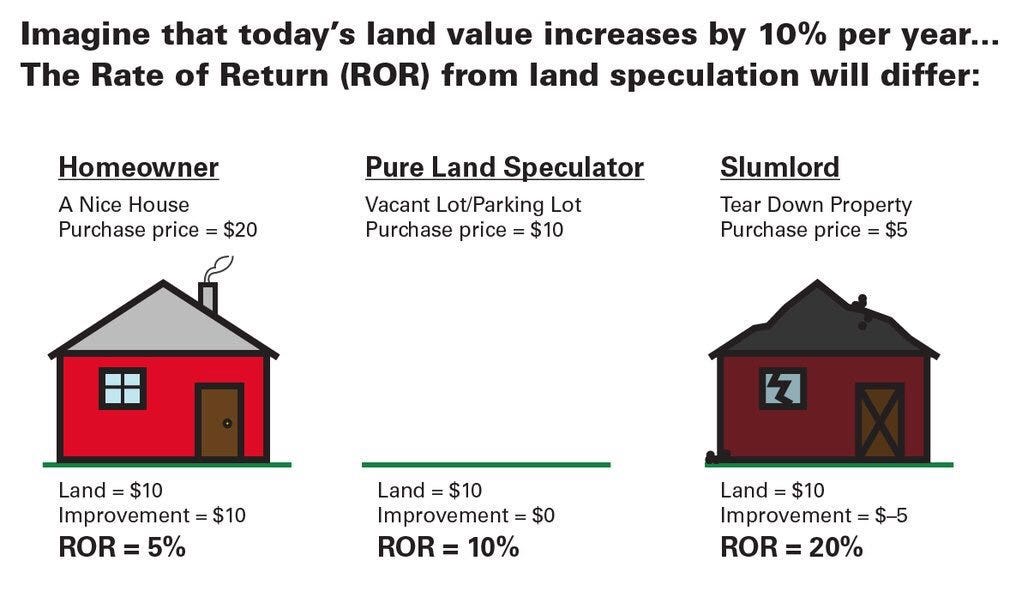
> virtually all economists agree that land value tax has zero "deadweight loss"–a fancy word for a drag on the economy that makes certain activities no longer profitable
Property taxes tax the land + the building. Building taxes are complicated to assess. They require tax assessments, appraisers, tax code, accountants to compute depreciation schedules, etc. The deadweight loss of property taxes is the economic loss of having resources devoted to filling out property tax filings. Appraisers and accountants would do other productive economic activities if they didn't spend all their time filling out tax forms.
Property taxes also distort incentives. If you improve your property, then you pay more tax. Property taxes can discourage you from using your land to its highest and best use.
Land taxes offer the opposite incentives. They encourage you to make your property better.
Land taxes would arguably help a lot of the housing crises. Landowners have to pay a lot more taxes if they want to convert a lot with a single family home to a 4-plex. A land tax wouldn't impose an additional tax to the landowner for improving the value of their land.